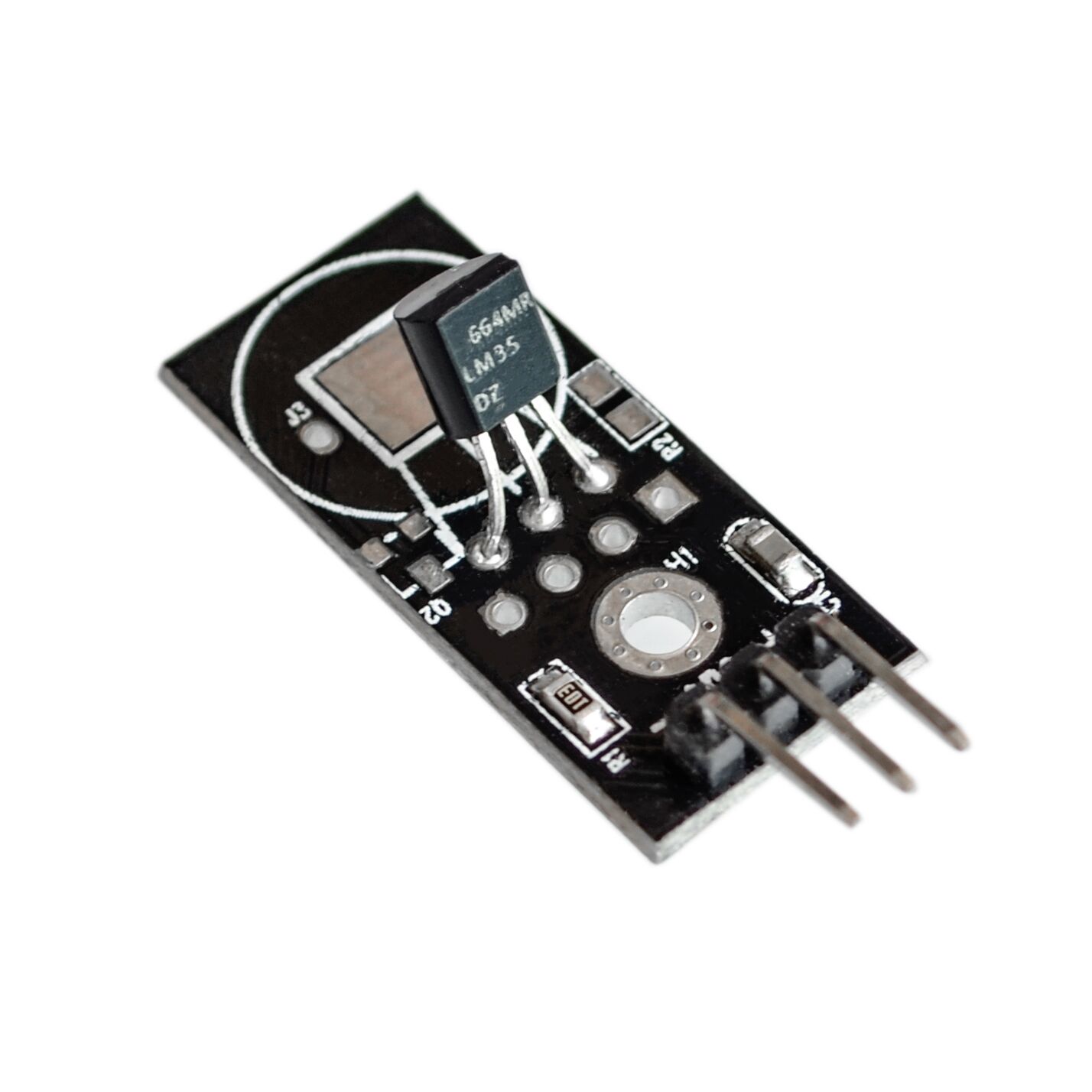
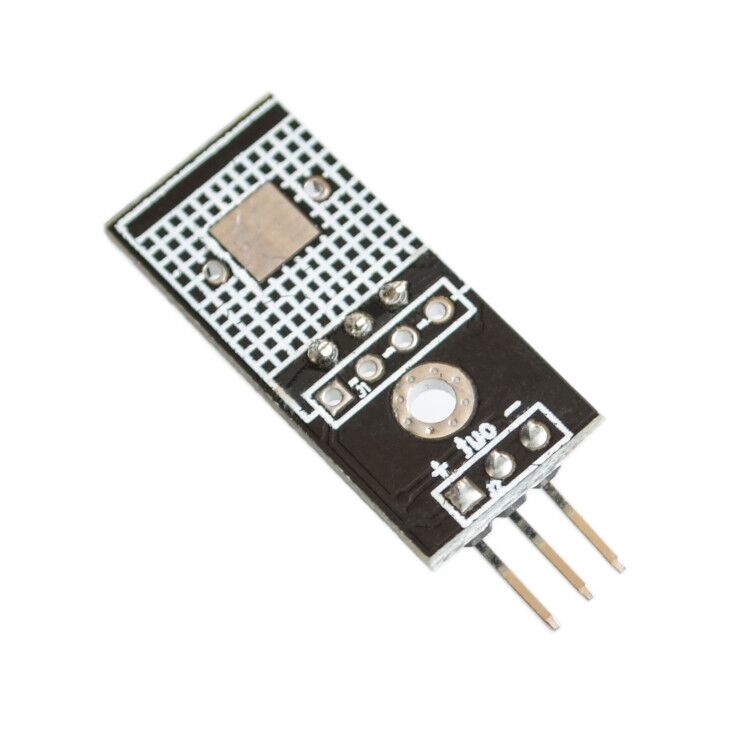
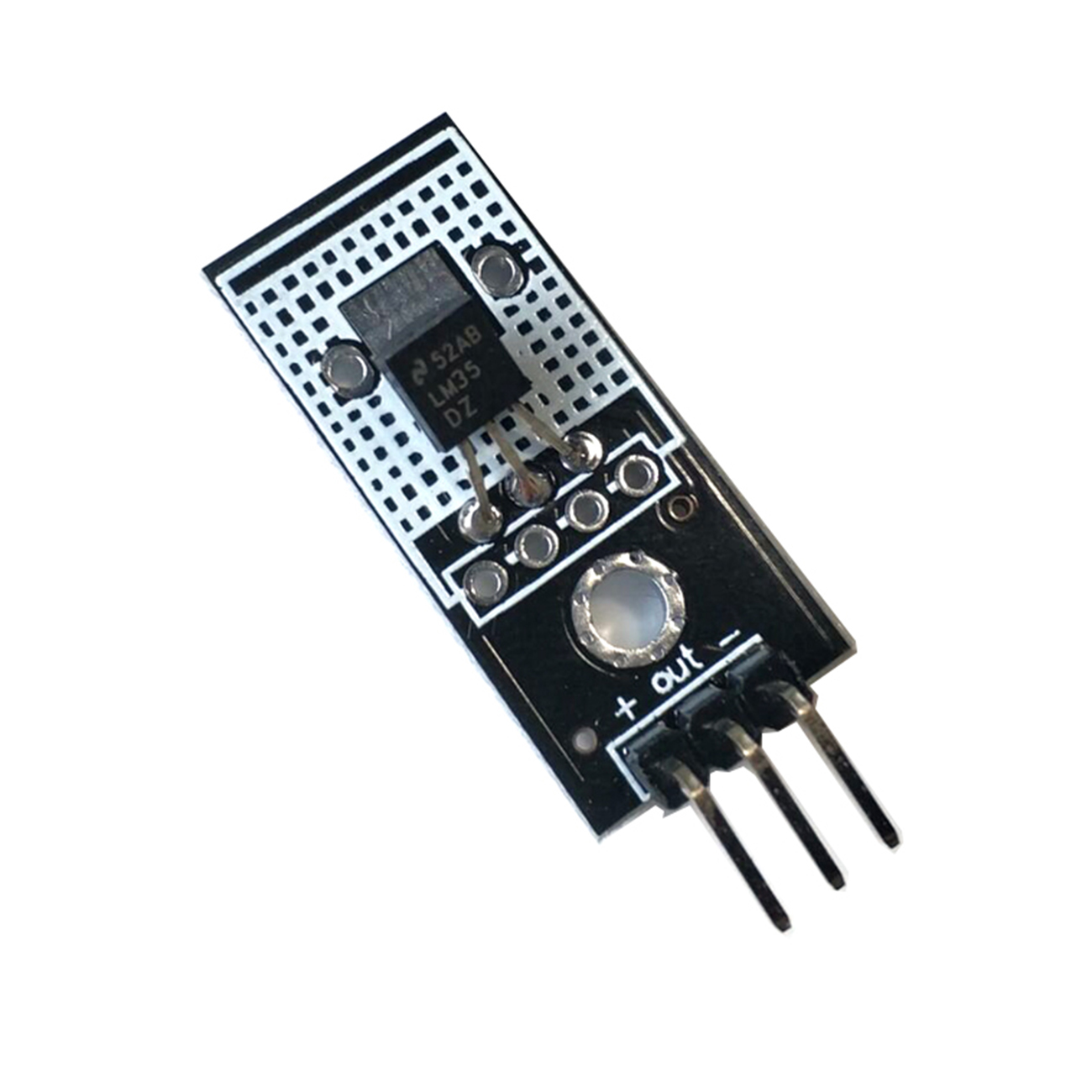
LM35DZ (Original) Analog Temprature Sensor Module

SKU: FA3066
Sensor IC

Texas Instruments LM35DZ (Original)

Package

TO-92 (3-pin)

Output Scale Factor

10mV/°C (linear)

Accuracy

±0.5°C at 25°C

Operating Voltage

4V – 30V DC

Current Drain

< 60µA

Output Impedance

0.1Ω at 1mA load

Output Type

Analog voltage

The LM35DZ (Original) Analog Temperature Sensor Module is a compact, ready-to-use breakout board built around the genuine Texas Instruments LM35DZ precision integrated-circuit temperature sensor. Unlike thermistors or other analog sensors that require complex calibration curves, the LM35DZ provides a linear output voltage directly proportional to temperature in Celsius at a scale factor of 10mV/°C — making it one of the simplest and most accurate analog temperature sensors for microcontroller projects.

At the heart of the module is the LM35DZ in a TO-92 package, featuring a linear +10mV/°C scale factor and 0.5°C ensured accuracy at 25°C . The output voltage is directly calibrated in Celsius, so no external calibration or trimming is required. The sensor operates across a wide temperature range and from a 4V to 30V supply while drawing less than 60µA, ensuring minimal self-heating (0.08°C in still air) and suitability for battery-powered applications .

The module includes an onboard decoupling capacitor to filter supply noise for stable readings. The output connects directly to any microcontroller ADC input, and the conversion is straightforward: Temperature (°C) = Vout (mV) / 10. With a low output impedance of 0.1Ω, the LM35DZ interfaces easily with readout and control circuitry .

Important Note: The LM35DZ provides an analog voltage output, not a digital signal. You must use an ADC to read it and apply the conversion formula. The sensor is not waterproof and should be kept dry. For accurate readings, ensure your ADC reference voltage is stable; using the Arduino’s internal reference can improve resolution and reduce supply noise effects. The LM35DZ is not a plug-and-play digital sensor — it requires code implementation for temperature conversion.

Whether you are building a weather station, a thermostat, a temperature logger, or an educational project, the LM35DZ module provides a reliable, linear, and easy-to-use solution for analog temperature measurement.

Features

  • Genuine Texas Instruments LM35DZ sensor — Precision analog temperature sensing

  • Linear 10mV/°C output — Direct Celsius calibration, no external trimming required

  • 0.5°C ensured accuracy — At 25°C ambient temperature

  • Wide supply voltage — Operates from 4V to 30V DC

  • Ultra-low current drain — Less than 60µA for minimal self-heating and battery compatibility

  • Low output impedance — 0.1Ω at 1mA load for easy interfacing

  • Onboard decoupling capacitor — Stable readings in noisy environments

  • TO-92 package — Standard through-hole sensor on a convenient breakout board

  • Wide application range — Weather stations, thermostats, data loggers, HVAC, education

  • Analog output — Direct connection to any microcontroller ADC input

Technical Specifications 

# Parameter Specification
1 Sensor IC Texas Instruments LM35DZ (Original)
2 Package TO-92 (3-pin)
3 Output Scale Factor 10mV/°C (linear)
4 Accuracy ±0.5°C at 25°C
5 Operating Voltage 4V – 30V DC
6 Current Drain < 60µA
7 Output Impedance 0.1Ω at 1mA load
8 Output Type Analog voltage

Usage

Getting Started

  1. Connect power — Connect VCC to 5V (or 4–30V) and GND to ground.

  2. Connect output — Connect the OUT pin to an analog input on your microcontroller (e.g., A0 on Arduino).

  3. Upload a test sketch — Read the analog value and convert it to temperature using the formula below.

  4. Verify readings — Compare against a known reference thermometer if needed.

Pin Connections

Module Pin Function
VCC Power (4V–30V, 5V typical)
GND Ground
OUT Analog voltage output (10mV/°C)

Conversion Formula

  • Temperature (°C) = (analogRead(A0) × Vref / ADC_Resolution) / 0.01

  • Example with 5V reference and 10-bit ADC: Temperature (°C) = analogRead(A0) × 5.0 / 1023 / 0.01

Example Arduino Code

cpp
#define LM35_PIN A0

void setup() {
  Serial.begin(9600);
}

void loop() {
  int raw = analogRead(LM35_PIN);
  float voltage = raw * (5.0 / 1023.0);
  float temperatureC = voltage / 0.01;

  Serial.print("Temperature: ");
  Serial.print(temperatureC);
  Serial.println(" °C");

  delay(1000);
}

Typical Applications

  • Weather stations — Ambient temperature logging

  • Thermostats — Temperature-based control systems

  • Data loggers — Long-term temperature recording

  • HVAC systems — Heating, ventilation, and air conditioning control

  • Educational projects — Teaching analog sensing and ADC principles

  • Battery temperature monitoring — Overheating protection in charging systems

Notes for Business Buyers

  • Analog output — Requires ADC and conversion formula; not a plug-and-play digital sensor

  • Original TI chip — Genuine LM35DZ ensures reliable linearity and accuracy

  • Not waterproof — Keep dry; for wet environments, use a waterproof DS18B20

  • Suitable for bulk purchasing — Ideal for educational kits, weather station manufacturers, and product developers

Q: What is the LM35DZ module used for?

It is an analog temperature sensor for measuring ambient temperature in weather stations, thermostats, data loggers, and educational projects.

Q: What is the output voltage relationship?

The LM35DZ outputs 10mV per °C. For example, 25°C = 250mV, 50°C = 500mV.

Q: What is the temperature range and accuracy?

The LM35DZ provides 0.5°C ensured accuracy at 25°C and operates over a wide temperature range .

Q: Does it require calibration?

No. The LM35DZ is factory-calibrated to provide a linear 10mV/°C output. No external trimming is required .

Q: What voltage does the module require?

It operates from 4V to 30V DC, with 5V being typical for Arduino .

Q: Can I connect it directly to an Arduino analog pin?

Yes. Connect the OUT pin to A0 and use the conversion formula in your code.

Q: Is the sensor waterproof?

No. The LM35DZ module is not waterproof and should be kept dry.

Q: Why is my temperature reading inaccurate?

Common causes include unstable ADC reference voltage and supply noise. Using the Arduino’s internal reference can improve accuracy.

Q: Does it come with a cable?

Check your specific product listing. The module itself is a breakout board; some listings include DuPont cables.

Q: Can I purchase in bulk for a product development project?

Yes. This module is suitable for bulk purchasing by educational kit suppliers, weather station manufacturers, and product developers.