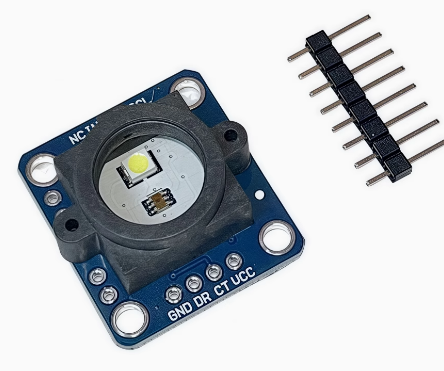
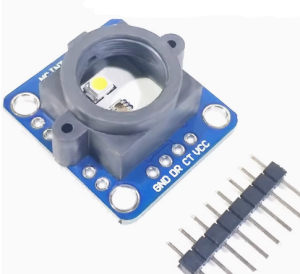
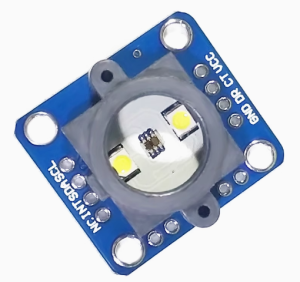
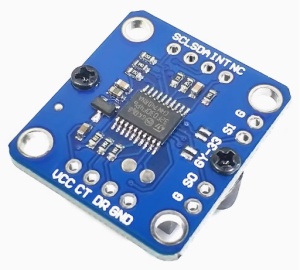
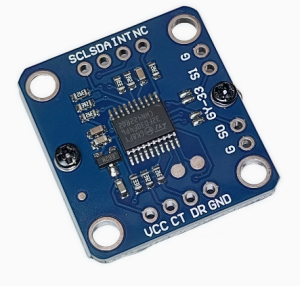
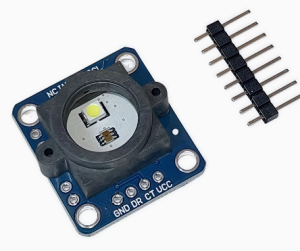
High-Precision GY-33 Color Recognition Sensor Module (TCS34725 Chip) – Compatible with TCS230 & TCS3200

SKU: FA3023-2
Sensor IC

AMS TCS34725

Channels

Red, Green, Blue, Clear (RGBC)

ADC Resolution

16-bit per channel

Interface

I²C (default address 0x29)

IR Blocking Filter

Integrated

Operating Voltage

3.3V – 5V DC (onboard regulator)

Onboard LEDs

4× white LEDs

Pin Count

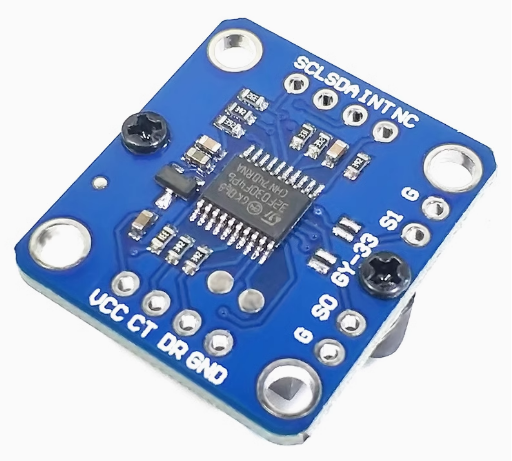
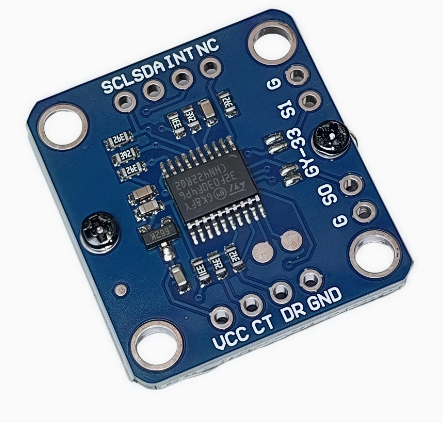
7 pins (VCC, GND, SDA, SCL, LED, INT, 3V3)

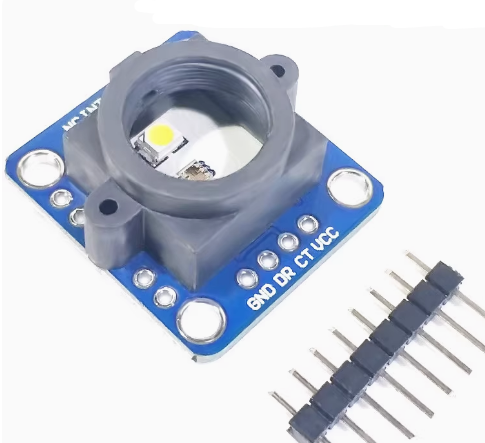
The GY-33 High-Precision Color Recognition Sensor Module is a complete, ready-to-use color detection board built around the AMS TCS34725 RGB color sensor IC. Unlike the older TCS230/TCS3200 frequency-output sensors, the GY-33 uses a direct I²C digital interface and performs on-chip color processing, including an integrated IR blocking filter, to deliver accurate, stable RGB and color temperature measurements without the need for complex calibration or frequency counting.

At the heart of the module is the TCS34725, a 4-channel digital color sensor that combines red, green, blue, and clear (unfiltered) photodiodes in a single package. The IR blocking filter is a key advantage: it minimizes the infrared component of ambient light, which would otherwise distort color readings and cause inaccurate results in environments with incandescent or sunlight illumination. This makes the GY-33 far more accurate and reliable than the TCS230/TCS3200 in real-world lighting conditions.

The module features a high-precision 16-bit analog-to-digital converter for each channel, providing high sensitivity and a wide dynamic range across varying light conditions. It communicates via a standard I²C interface (fast mode, 400kHz) with a default I²C address of 0x29, allowing direct connection to Arduino, ESP32, Raspberry Pi, STM32, and other microcontrollers. The onboard 3.3V regulator and level shifter ensure compatibility with both 3.3V and 5V logic systems, and the built-in LED illumination provides consistent light for reflective color sensing.

The GY-33 module includes several enhancements over a bare TCS34725 breakout:

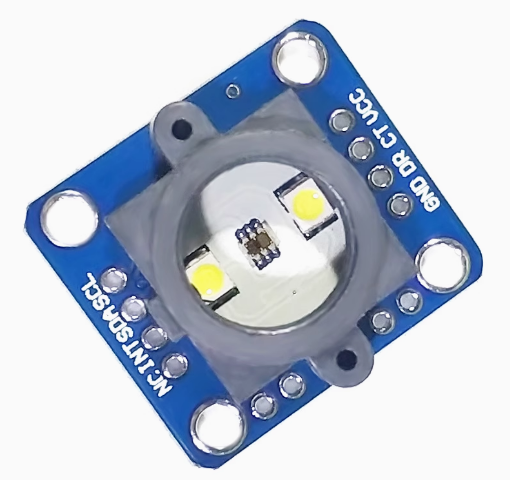
  • 4× white LEDs for consistent reflective illumination

  • 3.3V regulator and level shifter for 3.3V/5V compatibility

  • Onboard I²C pull-up resistors

  • Standard 0.1-inch pin header for easy connection

  • Compact PCB with mounting holes for easy integration

The module outputs raw RGB plus clear channel data (RGBC), along with calculated color temperature (CCT) and lux values via the sensor’s integrated algorithms. This makes it ideal for color temperature measurement, ambient light sensing, display backlight adjustment, and color identification applications. The GY-33 is also compatible with TCS230/TCS3200 code and libraries, making it an easy upgrade for existing projects that require better accuracy and simpler wiring.

The GY-33 is widely used in color sorting systems, RGB LED control and calibration, ambient light sensing, display color management, product inspection, plant growth monitoring, and educational STEM projects. It is also popular in smart home devices, mobile phone camera accessories, and wearable technology where accurate color sensing is required.

Important Note: The GY-33 uses I²C communication, so it is not a direct pin-compatible drop-in for TCS230/TCS3200 frequency-output modules — you must use the TCS34725 library and I²C protocol. The sensor measures reflected light, so sensing distance and illumination affect readings. For best results, maintain a fixed distance (typically 1–3cm) and use the onboard LEDs for consistent illumination. The IR filter reduces but does not eliminate infrared interference in very bright sunlight. The module is not waterproof and should be kept dry.

Whether you are building a color sorting machine, an RGB LED controller, or an ambient light sensing device, the GY-33 High-Precision Color Recognition Sensor Module provides a reliable, accurate solution with the convenience of I²C communication and on-chip IR filtering. It is suitable for individual makers, students, and businesses purchasing in bulk for product development or educational programs.

Features

  • TCS34725 RGB color sensor IC — 4-channel RGB + Clear photodiode array

  • Integrated IR blocking filter — Reduces infrared interference for accurate color readings

  • High-precision 16-bit ADC — High sensitivity and wide dynamic range per channel

  • I²C digital interface — Standard I²C communication (0x29), no ADC or frequency counting required

  • Onboard 3.3V regulator and level shifter — Compatible with both 3.3V and 5V microcontrollers

  • Four white LEDs onboard — Consistent illumination for reflective color sensing

  • Onboard I²C pull-up resistors — Ready for direct connection

  • Compact form factor — With mounting holes for easy integration

  • Wide application range — Color sorting, RGB LED control, ambient light sensing, product inspection

  • Compatible with TCS230/TCS3200 projects — Easy upgrade path for existing color sensing designs

Technical Specifications 

# Parameter Specification
1 Sensor IC AMS TCS34725
2 Channels Red, Green, Blue, Clear (RGBC)
3 ADC Resolution 16-bit per channel
4 Interface I²C (default address 0x29)
5 IR Blocking Filter Integrated
6 Operating Voltage 3.3V – 5V DC (onboard regulator)
7 Onboard LEDs 4× white LEDs
8 Pin Count 7 pins (VCC, GND, SDA, SCL, LED, INT, 3V3)

Usage

Getting Started

  1. Connect power — Supply 3.3V or 5V DC to the VCC pin and GND to ground. The module includes an onboard 3.3V regulator.

  2. Connect I²C lines — Connect SDA to your microcontroller’s I²C data line and SCL to the I²C clock line:

    • Arduino Uno: SDA → A4, SCL → A5

    • ESP32: SDA → GPIO21, SCL → GPIO22 (default)

    • ESP8266: SDA → D2, SCL → D1

    • Raspberry Pi: SDA → GPIO2, SCL → GPIO3

  3. Install the library — Install the Adafruit TCS34725 library through the Arduino Library Manager, along with Adafruit BusIO.

  4. Upload a test sketch — Open the tcs34725 example and upload it. Open the Serial Monitor to see RGB, clear, color temperature, and lux values.

  5. Enable LEDs (optional) — Connect the LED pin to a digital output or to VCC to enable the onboard illumination for reflective color sensing.

  6. Implement color detection — Use the RGB and clear values to identify colors, measure color temperature, or control RGB LEDs.

Pin Connections

Module Pin Function
VCC Power (3.3V–5V)
GND Ground
SDA I²C Data
SCL I²C Clock
LED Onboard LED control
INT Interrupt output (optional)
3V3 3.3V output (for reference)

Example Arduino Code

cpp
#include <Wire.h>
#include <Adafruit_TCS34725.h>

Adafruit_TCS34725 tcs = Adafruit_TCS34725(TCS34725_INTEGRATIONTIME_50MS, TCS34725_GAIN_4X);

void setup() {
  Serial.begin(9600);
  if (!tcs.begin()) {
    Serial.println("No TCS34725 found!");
    while (1);
  }
  Serial.println("TCS34725 found!");
}

void loop() {
  uint16_t r, g, b, c;
  tcs.getRawData(&r, &g, &b, &c);

  uint16_t colorTemp = tcs.calculateColorTemperature_dn40(r, g, b, c);
  uint16_t lux = tcs.calculateLux(r, g, b);

  Serial.print("R: "); Serial.print(r);
  Serial.print(" G: "); Serial.print(g);
  Serial.print(" B: "); Serial.print(b);
  Serial.print(" C: "); Serial.print(c);
  Serial.print(" Temp: "); Serial.print(colorTemp); Serial.print("K");
  Serial.print(" Lux: "); Serial.println(lux);

  delay(200);
}

Typical Applications

  • Color sorting systems — Identify and sort objects by color with high accuracy

  • RGB LED control — Match LED colors to detected colors

  • Ambient light sensing — Measure light intensity and color temperature

  • Display backlight adjustment — Adaptive brightness and color temperature

  • Product inspection — Verify color consistency in manufacturing

  • Plant growth monitoring — Measure light spectrum for horticulture

  • Educational STEM projects — Teaching color sensing and I²C communication

Notes for Business Buyers

  • I²C simplicity — No ADC or frequency counting required; direct digital readout.

  • IR filter accuracy — Integrated IR blocking filter provides accurate color readings in varied lighting.

  • Onboard LEDs and regulator — Ready for immediate use with 3.3V and 5V systems.

  • Suitable for bulk purchasing — Ideal for sorting machine manufacturers, RGB lighting integrators, and educational institutions.

Q: What is the GY-33 Color Recognition Sensor Module used for?

It is a high-precision color detection module for identifying and measuring colors, used in color sorting machines, RGB LED control, ambient light sensing, and product inspection.

Q: What is the difference between GY-33 (TCS34725) and TCS230/TCS3200?

The TCS34725 uses I²C communication and has an integrated IR blocking filter for accurate color readings. The TCS230/TCS3200 uses frequency output and lacks IR filtering, requiring more calibration and being more susceptible to IR interference.

Q: What is the output data format?

The module outputs 16-bit RGBC data (Red, Green, Blue, Clear) via I²C, along with calculated color temperature (CCT) and lux values.

Q: What is the I²C address?

The default I²C address is 0x29 (7-bit).

Q: What voltage does the module require?

It operates from 3.3V or 5V DC thanks to its onboard 3.3V regulator and level shifter.

Q: Do I need to calibrate the sensor?

The TCS34725 includes an IR blocking filter and on-chip processing, so calibration requirements are minimal compared to TCS230/TCS3200. For precise color matching, you can still normalize readings against white and black references.

Q: What is the purpose of the onboard LEDs?

The four white LEDs provide consistent illumination for reflective color sensing, reducing the effects of ambient light variation.

Q: Can I use this module with existing TCS3200 code?

Not directly. The GY-33 uses I²C, not frequency output. You must use the Adafruit TCS34725 library or similar I²C-based library.

Q: Is the module affected by sunlight?

The IR filter reduces infrared interference, but very bright sunlight can still affect accuracy. Use the onboard LEDs and shield the sensor from direct sunlight for best results.

Q: Can I purchase in bulk for a product development project?

Yes. This module is suitable for both individual users and business purchasing, including sorting machine manufacturers, RGB lighting integrators, and educational institutions.