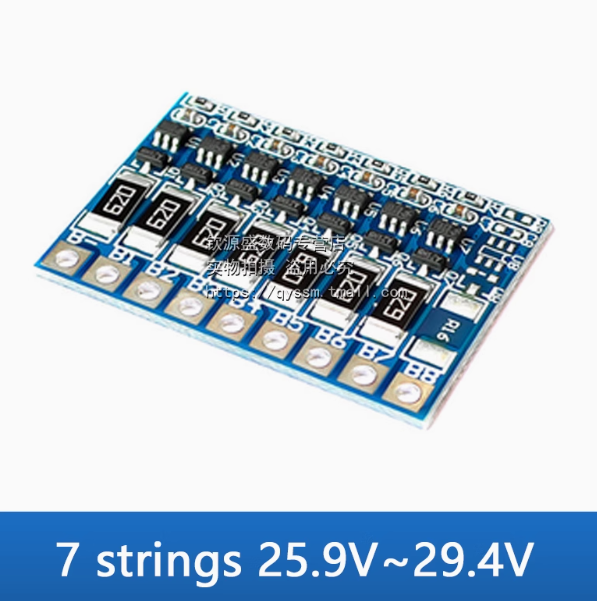
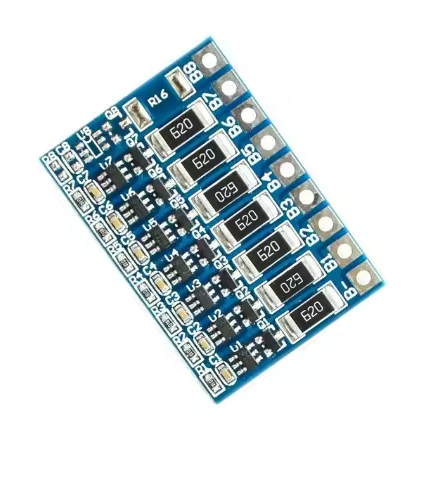
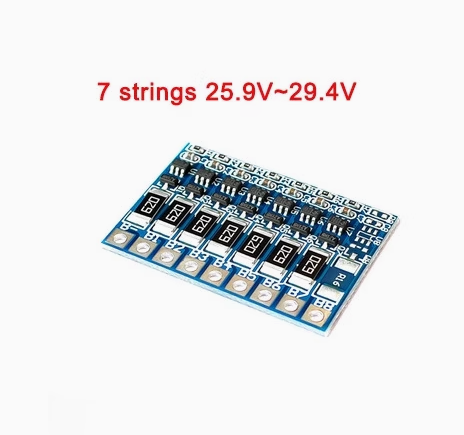
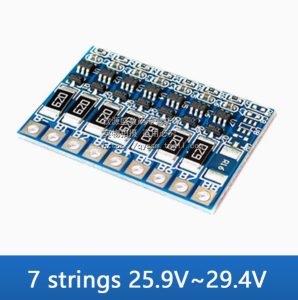
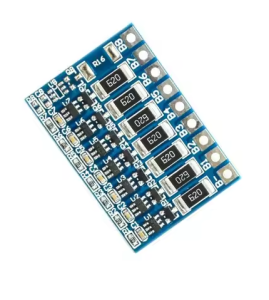
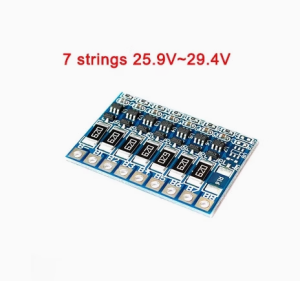
The 7S 18650 Lithium Battery Balance Board is a versatile, intelligent charging protection module designed for multi-cell lithium-ion and lithium-polymer battery packs. It supports 7S configurations specifically, while also being compatible with up to 8S packs (11.1V to 33.6V). This universal balance board ensures even charge distribution across all cells, maximizing pack lifespan and preventing individual cell overcharge.
At the heart of the board is a smart balancing circuit that continuously monitors the voltage of each individual cell during charging. When any cell reaches the target voltage before others, the board bleeds off excess charge through precision resistors, allowing the other cells to catch up. This ensures all cells in the pack reach the same voltage, preventing overcharge of individual cells and maximizing overall pack capacity and lifespan.
The board supports a wide voltage range from 11.1V to 33.6V, making it compatible with a broad range of battery pack configurations. Whether you are building a 7S pack for a power tool or an 8S pack for an e-bike or energy storage system, this balance board provides reliable, automatic cell equalization.
The “7S” designation indicates the board’s primary configuration, but it is also compatible with 8S packs. This dual compatibility makes it a flexible solution for builders working with 7-cell or 8-cell battery packs. The board automatically detects the connected cell count and adjusts its balancing behavior accordingly.
The universal design means the board can be used with different cell counts within its supported range without requiring separate modules for each configuration. This simplifies inventory management for businesses and reduces costs for individual builders.
The board features solder pads or connector pins for easy integration into battery packs. The exposed pads allow you to solder wires directly to the board, while also being compatible with standard connectors for modular pack designs. The board includes connection points for each cell mid-point, plus B+ and B- for the main pack terminals.
The smart charging protection extends beyond simple balancing. The board helps prevent:
-
Overcharge of individual cells — By bleeding excess charge, it prevents any single cell from exceeding its safe voltage limit.
-
Cell voltage divergence — Regular balancing keeps all cells at similar voltages, preventing capacity loss over time.
-
Premature pack failure — Balanced cells age more evenly, extending overall pack lifespan.
The board is widely used in e-bike batteries, solar energy storage systems, portable power stations, power tools, DIY power banks, and RC vehicles. It is also popular in educational projects for teaching battery management and cell balancing principles.
Important Note: This balance board is designed for 7S and 8S lithium-ion and lithium-polymer battery packs. Always verify the voltage and current ratings match your application before installation. The board provides balancing only — it does not replace the need for a full BMS with overcharge, over-discharge, and overcurrent protection. For complete battery safety, use this board in conjunction with a proper BMS.
Whether you are building a custom 7S battery pack for a power tool, assembling an 8S e-bike battery, or adding balancing to an existing pack, the 7S 18650 Lithium Battery Balance Board provides a reliable, flexible solution. It is suitable for individual makers, engineers, and businesses purchasing in bulk for product development or industrial applications.
Features
-
7S primary configuration — Optimized for 7-cell lithium battery packs
-
8S compatible — Also works with 8-cell packs for added flexibility
-
Smart balancing circuit — Automatically equalizes cell voltages during charging
-
Wide voltage range — Supports 11.1V to 33.6V systems
-
Automatic cell detection — Adjusts balancing behavior based on connected cell count
-
Comprehensive protection — Helps prevent overcharge of individual cells
-
Extends pack lifespan — Balanced cells age more evenly, maximizing overall pack life
-
Wide application range — E-bikes, solar storage, power tools, RC vehicles
Technical Specifications
| # | Parameter | Specification |
|---|---|---|
| 1 | Compatible Battery | 7S – 8S lithium-ion / lithium-polymer |
| 2 | Voltage Range | 11.1V – 33.6V |
| 3 | Balancing Method | Passive (resistive bleed) |
| 4 | Cell Detection | Automatic |
| 5 | Connection Type | Solder pads / connector pins |
| 6 | Board Type | Universal balance board |
| 7 | Primary Configuration | 7S (also compatible with 8S) |
| 8 | Module Dimensions | Compact PCB for battery packs |