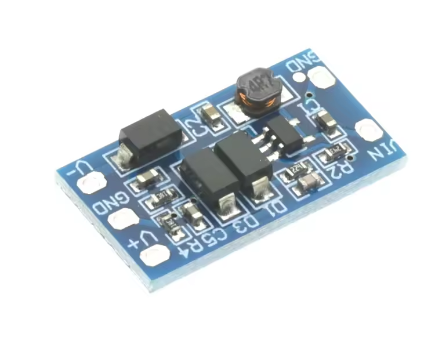
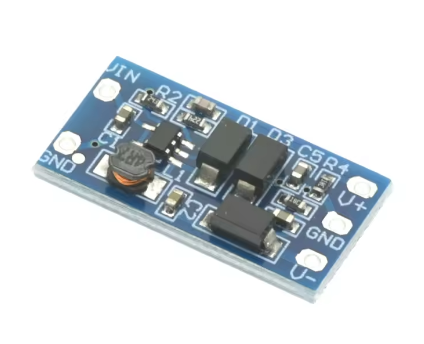
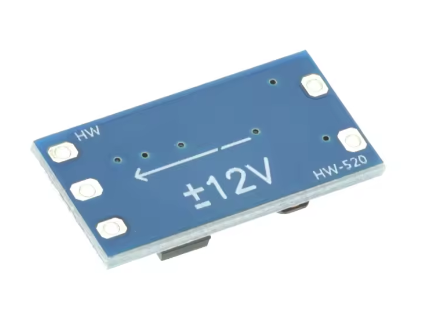
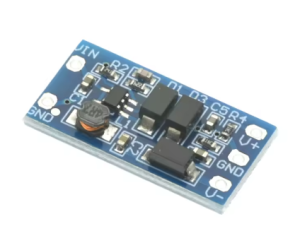
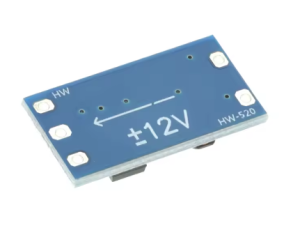
The 5V to ±12V DC-DC Boost Converter Module is a compact, high-efficiency power supply board designed to generate dual ±12V outputs from a low-voltage 2.8V to 5.5V DC input. It is an ideal solution for powering operational amplifiers (op-amps), audio circuits, analog signal processing systems, and other applications requiring bipolar supplies from a single low-voltage source such as a USB port, single-cell lithium battery, or 3.3V/5V rail.
At the heart of the module is a high-frequency boost converter circuit combined with a voltage inversion stage that generates both positive and negative 12V rails. This allows the module to output +12V and -12V simultaneously from a single positive input — eliminating the need for separate power supplies or complex transformer-based circuits.
The module accepts a wide input voltage range of 2.8V to 5.5V DC, making it compatible with:
-
USB power (5V)
-
Single-cell lithium batteries (3.0V–4.2V)
-
3.3V and 5V microcontroller rails
-
Portable power banks
The dual ±12V output provides ample voltage for a wide range of analog and mixed-signal circuits, including:
-
Operational amplifier circuits (op-amps)
-
Audio amplifiers and preamplifiers
-
Analog-to-digital converters (ADCs)
-
Digital-to-analog converters (DACs)
-
Sensor interfaces requiring bipolar supplies
-
Industrial control and instrumentation
The module uses high-efficiency switching regulation, minimizing power loss and heat generation compared to linear regulators. This makes it suitable for battery-powered and portable applications where efficiency is critical. The compact PCB design with mounting holes allows easy integration into equipment enclosures, project boxes, and control panels.
The module features screw terminals or pin headers for secure input and output connections. The output terminals are clearly labeled for +12V, GND, and -12V, simplifying wiring and reducing connection errors. The module includes built-in protection circuits including overcurrent protection and thermal shutdown, ensuring safe and reliable operation.
The low input voltage capability is a key advantage. Unlike many dual-output modules that require 12V or higher input, this module operates from as low as 2.8V, making it perfect for USB-powered and battery-powered projects where only a low-voltage source is available.
The module is widely used in audio equipment, operational amplifier circuits, portable instrumentation, USB-powered devices, analog signal processing, and any application requiring dual-polarity power supplies from a low-voltage input source.
Important Note: The module is designed to output ±12V from a 2.8V–5.5V input. Ensure your input power source can supply sufficient current for the desired output load. The maximum output current depends on the input voltage and the specific variant. Always verify the voltage and current ratings match your application before installation.
Whether you are building a USB-powered audio amplifier, designing a portable analog circuit, or adding dual-supply capability to a battery-powered project, the 5V to ±12V DC-DC Boost Converter Module provides a reliable, efficient solution. It is suitable for individual makers, engineers, and businesses purchasing in bulk for product development or industrial applications.
Features
-
Dual ±12V output — Generates positive and negative 12V rails simultaneously
-
Wide input range — Operates from 2.8V to 5.5V DC
-
USB and battery compatible — Perfect for 5V USB power and single-cell lithium batteries
-
High efficiency — Switching regulation minimizes power loss
-
Compact PCB design — With mounting holes for easy integration
-
Clear output labeling — +12V, GND, and -12V terminals for simple wiring
-
Built-in protection — Overcurrent protection and thermal shutdown
-
Wide application range — Audio, op-amp circuits, portable instrumentation, USB devices
Technical Specifications
| # | Parameter | Specification |
|---|---|---|
| 1 | Module Type | Boost converter with dual output |
| 2 | Input Voltage | 2.8V – 5.5V DC |
| 3 | Output Voltage | ±12V DC |
| 4 | Output Current | Variant dependent |
| 5 | Conversion Type | Boost + voltage inversion |
| 6 | Output Terminals | +12V, GND, -12V |
| 7 | Protection | Overcurrent, thermal shutdown |
| 8 | Module Dimensions | Compact PCB with mounting holes |