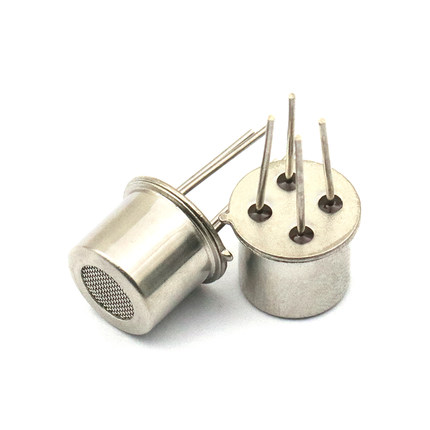
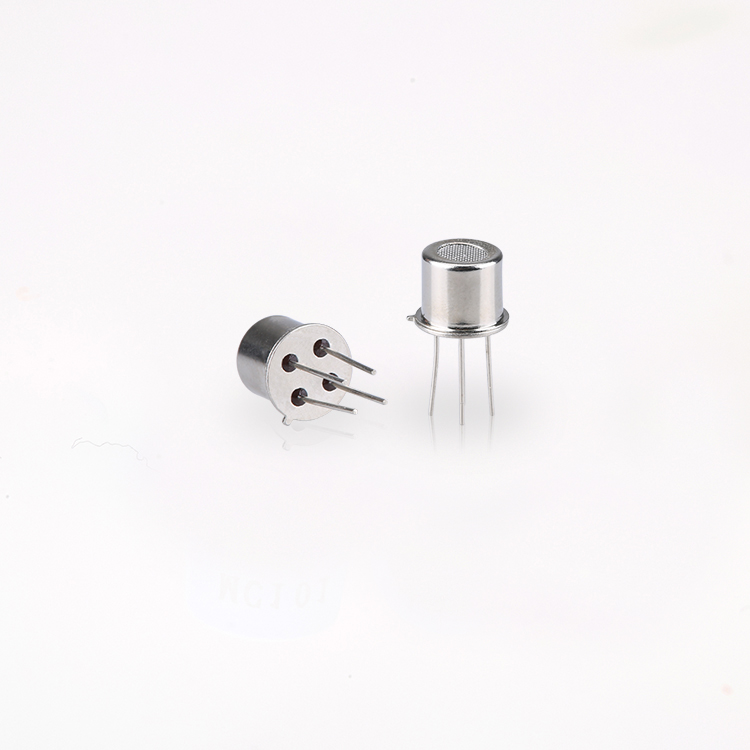
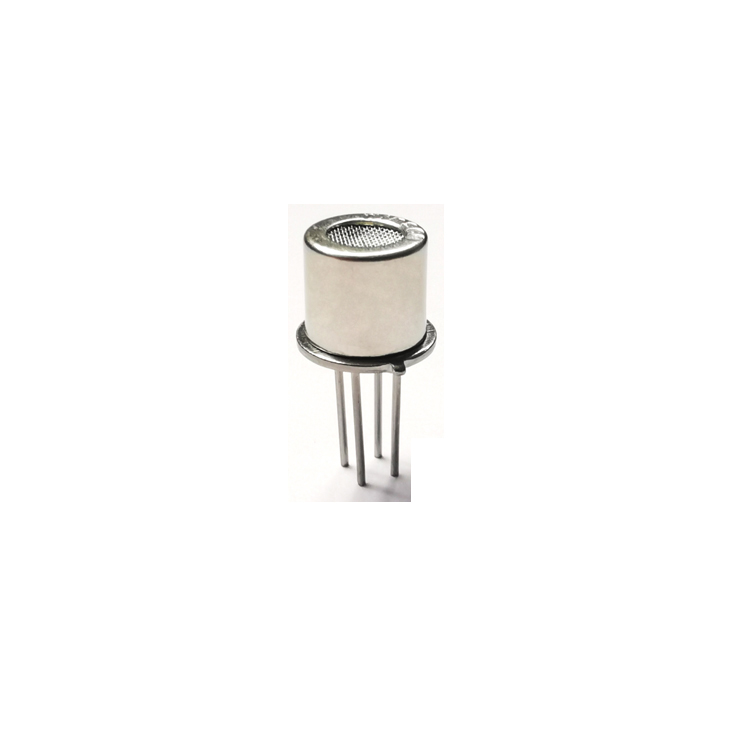
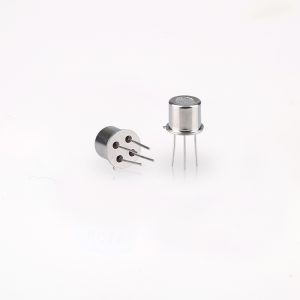
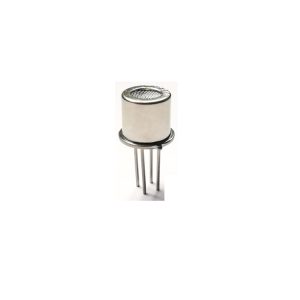
The MP135 Air Pollution Gas Sensor is a compact, DIP-4 packaged semiconductor gas sensor designed for general air-quality trend monitoring and the detection of reducing gases such as hydrogen (H₂), carbon monoxide (CO), and alcohol vapors . It is a practical, low-cost choice for applications like automatic exhaust fans, air cleaners, and indoor air quality indicators where a simple, indicative response to air pollution is sufficient.
At the heart of the sensor is a metal oxide semiconductor (MOS) sensing element (typically SnO₂-based) deposited on a miniature Al₂O₃ ceramic substrate. The integrated heater maintains the sensor at its optimal operating temperature. When reducing gases are present, the sensor‘s conductivity increases proportionally with gas concentration. Users can convert this conductivity change into a usable voltage signal using a simple external circuit with a load resistor .
The DIP-4 package features four pins: two for the heater circuit and two for the sensing electrode. The heater requires 5.0V ± 0.1V (AC or DC) and consumes ≤300mW, making it suitable for continuous operation in low-power monitoring devices . The sensor exhibits high sensitivity and quick response/recovery characteristics, with a sensitivity ratio (Rs in air / Rs in 50ppm H₂) of at least 3 .
Important Note: The MP135 is a non-selective MOS sensor. It cannot distinguish between specific gases and is affected by ambient temperature and humidity variations . It provides relative trend data, not calibrated absolute ppm readings for any specific gas. The sensor requires a warm-up time of more than 48 hours before stable operation . It is not waterproof and must be protected from water condensation, high humidity, and corrosive gases. Exposure to organic silicon vapors can permanently destroy sensitivity . For precise, gas-specific measurements, a different sensor type (such as electrochemical or NDIR) is recommended.
Whether you are building a simple air quality alarm, an automatic ventilation controller, or an educational gas-sensing project, the MP135 provides a reliable, cost-effective entry point for detecting common reducing gases in the air.
Features
-
MOS semiconductor sensing element — Detects H₂, CO, and alcohol vapors (VOC-like reducing gases)
-
DIP-4 package — Standard through-hole format for easy PCB and breadboard integration
-
Low power consumption — Heater power ≤300mW at 5.0V
-
High sensitivity — Rs(air)/Rs(50ppm H₂) ≥ 3
-
Quick response and recovery — Suitable for real-time trend monitoring
-
Simple detection circuit — Only requires a load resistor and basic voltage divider
-
Good stability and long life — Proven thick-film manufacturing technology
-
Wide application range — Air cleaners, automatic exhaust, household/office harmful gas detection
Technical Specifications
Usage
Getting Started
-
Identify the pins — Pin 1 & 2 are the heater electrode; Pin 3 & 4 are the measuring electrode. The protuberance mark on the cap indicates Pin 1 .
-
Design the heater circuit — Apply 5.0V ± 0.1V across the heater pins (Pin 1 & 2). This can be DC or AC, but must be stable for consistent sensor temperature.
-
Design the sensing circuit — Connect the measuring electrode (Pin 3 & 4) in series with a load resistor (RL). Apply a loop voltage (VC ≤ 24V DC) across the series combination. The voltage across RL (VRL) is your output signal.
-
Warm up — Power the sensor for more than 48 hours in clean air before taking meaningful readings. This stabilizes the sensing material .
-
Calibrate (recommended) — Record the VRL value in clean air as a baseline. The sensor’s response is logarithmic, so calibration against a known gas concentration is necessary for any quantitative estimation.
-
Implement control logic — Use the analog voltage from VRL to trigger exhaust fans, alarms, or data logging when it deviates from the clean-air baseline.
Pin Connections (DIP-4)
Basic Test Circuit Values (Standard Condition)
Typical Applications
-
Air cleaners and purifiers — Trigger fan speed increase when pollution is detected
-
Automatic exhaust systems — Activate ventilation in kitchens or workshops
-
Household and office gas detection — General indicator for harmful gas presence
-
Educational projects — Teaching MOS sensor principles and analog signal conditioning
Notes for Business Buyers
-
Non-selective sensor — Cannot distinguish between H₂, CO, and alcohol; suitable for trend and alarm applications, not gas-specific measurement
-
48-hour warm-up required — Factor this into production testing and deployment timelines
-
Environmental sensitivity — Readings are affected by temperature and humidity; calibration in the target environment is recommended
-
Suitable for bulk purchasing — Ideal for air cleaner manufacturers, educational kit suppliers, and general air-quality monitor developers
Q: What is the MP135 sensor used for?
It is a general-purpose MOS gas sensor for detecting reducing gases (H₂, CO, alcohol) in air quality monitoring, automatic exhaust systems, and air cleaners .
Q: Can the MP135 distinguish between H₂, CO, and alcohol?
No. It is a non-selective MOS sensor. It responds to all reducing gases and cannot identify which specific gas is present .
Q: What is the detection range?
The detection range is 10–500 ppm for H₂ and CO, and 5–500 ppm for alcohol .
Q: Why does the sensor need a 48-hour warm-up?
The MOS sensing material requires prolonged heating to reach a stable baseline. Winsen specifies a warm-up time of more than 48 hours for reliable operation .
Q: What voltage does the heater require?
The heater requires 5.0V ± 0.1V, which can be AC or DC, with a power consumption of ≤300mW .
Q: What is the difference between VH and VC?
VH is the heater voltage that maintains the sensing element‘s operating temperature. VC is the circuit voltage applied across the sensor and load resistor to generate the output signal .
Q: How do I read the sensor output?
Connect a load resistor (RL) in series with the sensor and measure the voltage across RL. This voltage changes as gas concentration changes.
Q: Can I use this sensor outdoors?
The sensor is sensitive to humidity and condensation. It is not waterproof and should be protected from water and high humidity. Indoor use is recommended .
Q: What destroys the sensor’s sensitivity?
Exposure to organic silicon vapors, high concentrations of corrosive gases (H₂S, SOx, Cl₂), or alkali metal salts can permanently degrade or destroy the sensing material .
Q: Can I purchase in bulk for a product development project?
Yes. The MP135 is suitable for bulk purchasing by air cleaner manufacturers, educational kit suppliers, and air-quality monitor developers.