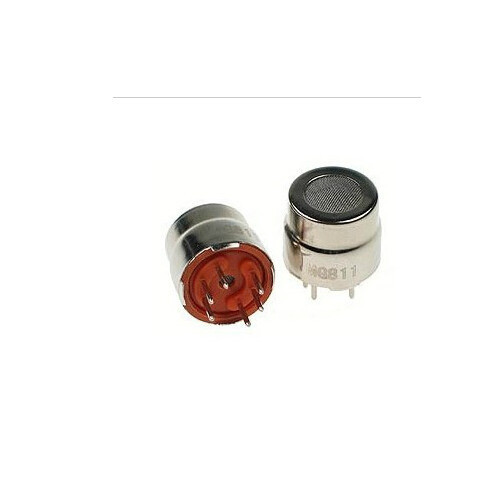
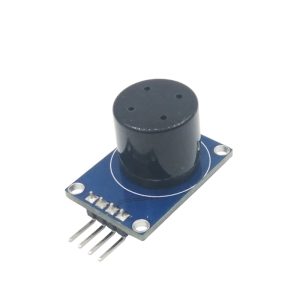
The MG811 Electrolyte CO2 Sensor is a solid-electrolyte electrochemical gas sensor designed for detecting carbon dioxide concentration in air quality control systems, fermentation processes, and greenhouse environments. Unlike semiconductor MOX sensors like the MQ-135 that respond to a broad range of gases, the MG811 offers good sensitivity and selectivity to CO2, making it a more targeted choice for carbon dioxide monitoring applications.
At the heart of the sensor is a solid electrolyte battery principle. When the sensor is heated to its operating temperature and exposed to CO2, an electrode reaction occurs between the sensitive electrode and the reference electrode, generating an electromotive force (EMF). The output signal voltage has a logarithmic inverse relationship with CO2 concentration — as CO2 levels rise, the output voltage decreases. This allows the sensor to detect CO2 across a range of 0 to 10,000 ppm, with a zero-point EMF of 300–500 mV in 400 ppm CO2 and an output signal change (ΔEMF) of at least 25 mV between 400 ppm and 1000 ppm.
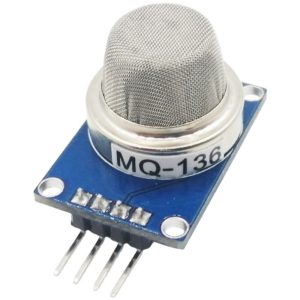
The sensor requires a heating voltage of 6.0V ± 0.1V (AC or DC) to reach its operating temperature, with a heating current of approximately 140–200 mA and power consumption around 850–1200 mW depending on the variant. This significant heater current means the module cannot be powered from a USB port alone — an external power supply (typically 7–12V) is required for the microcontroller board when using this sensor. The module includes an onboard conditioning circuit that amplifies the sensor’s high-impedance output signal, and a potentiometer for setting a digital threshold that triggers an onboard LED and digital output when CO2 levels exceed the set point.
Important Note: The MG811 is an electrochemical sensor that requires careful calibration before meaningful measurements can be made. DFRobot’s official guidance recommends powering the sensor in clean air for approximately 48 hours to stabilize, then measuring the output voltage and entering that value into the calibration code (dividing the measured voltage by the amplifier gain of 8.5). The sensor also needs calibration at 400 ppm (ambient) and 1000 ppm reference points for accurate ppm readings. The sensor’s high-impedance output (requiring amplifier impedance in the 100–1000 GΩ range) and logarithmic response mean that precise absolute CO2 measurement is challenging — the sensor is better suited for trend monitoring and threshold-based alarm applications than for laboratory-grade CO2 measurement. The sensor is not waterproof and should be kept dry. Operating temperature range is -20°C to +50°C.
Whether you are building a greenhouse CO2 enrichment controller, an indoor air quality monitor, or a fermentation process alarm, the MG811 sensor provides a targeted electrochemical solution for carbon dioxide detection with the documentation and community support of a widely used DFRobot-compatible module.
Features
-
Solid-electrolyte electrochemical CO2 sensor — Good sensitivity and selectivity to carbon dioxide
-
0–10,000 ppm detection range — Suitable for ambient to enriched CO2 environments
-
Logarithmic voltage output — Output voltage decreases as CO2 concentration increases
-
6.0V heater with onboard conditioning circuit — Maintains optimal sensor temperature and amplifies the high-impedance signal
-
Adjustable digital threshold — Potentiometer sets alarm trigger point with LED indication
-
Analog and digital outputs — Analog for trend monitoring, digital for threshold alarms
-
Low humidity and temperature dependency — More stable than many semiconductor gas sensors
-
Wide application range — Greenhouse CO2 control, fermentation monitoring, indoor air quality
-
DFRobot-compatible module — Extensive documentation, sample code, and community support
-
Long lifespan — Solid electrolyte construction for stable long-term operation
Technical Specifications
Usage
Getting Started
-
Connect power — The sensor module requires 6V for the heater and typically 5V for the logic circuit. An external power supply (7–12V) is required to power the microcontroller board; do not rely on USB power alone.
-
Connect outputs — Connect the analog output (AOUT) to an analog input on your microcontroller (e.g., A0 on Arduino). Connect the digital output (DOUT) to a digital input if threshold alarm detection is needed.
-
Preheat and calibrate — This is the most critical step. Power the sensor in clean outdoor air for approximately 48 hours. Measure the output voltage, then update the ZERO_POINT_VOLTAGE in your code with the measured voltage divided by the amplifier gain (8.5 for DFRobot modules).
-
Set the threshold (optional) — Adjust the onboard potentiometer so the red LED turns off at your desired baseline. When CO2 rises and voltage drops below the threshold, the LED lights and the digital output triggers.
-
Read data — Use analogRead() for voltage trends and the calibration curve to estimate ppm, or digitalRead() for simple alarm triggering.
Pin Connections
Example Arduino Code (Reading Analog Voltage)
#define MG_PIN A0
#define DC_GAIN 8.5

void setup() {
  Serial.begin(9600);
}

void loop() {
  int raw = analogRead(MG_PIN);
  float voltage = raw * (5.0 / 1023.0);
  Serial.print("Voltage: ");
  Serial.print(voltage);
  Serial.println(" V");
  delay(1000);
}
Typical Applications
-
Greenhouse CO2 enrichment — Monitor and control CO2 levels for optimal plant growth
-
Indoor air quality monitoring — Track CO2 buildup in classrooms, offices, and meeting rooms
-
Fermentation process control — Monitor CO2 production in brewing and bio-reactor systems
-
HVAC demand-controlled ventilation — Activate ventilation when CO2 exceeds threshold
-
Educational STEM projects — Teaching electrochemical sensing and calibration principles
Notes for Business Buyers
-
Calibration is essential — The 48-hour preheat and 400/1000 ppm calibration are required for meaningful readings; factor this into production testing timelines
-
External power required — The heater draws significant current; USB power is insufficient for the microcontroller when the sensor is active
-
Not a precision instrument — The logarithmic response and high-impedance output make absolute ppm measurement challenging; better suited for trend and threshold applications
-
Suitable for bulk purchasing — Ideal for greenhouse controller manufacturers, air quality monitor developers, and educational institutions
Q: What is the MG811 sensor used for?
It is a solid-electrolyte CO2 sensor for air quality control, greenhouse CO2 monitoring, and fermentation process control, offering good selectivity to carbon dioxide.
Q: What is the difference between MG811 and MQ-135?
The MG811 uses a solid electrolyte and is selective to CO2 with a logarithmic voltage response. The MQ-135 is a semiconductor sensor that responds to a broad range of gases (NH3, benzene, smoke, etc.) and is not specifically selective to CO2.
Q: Why does the sensor need a long preheat time?
The solid electrolyte requires heating to reach stable operating temperature. DFRobot recommends 48 hours of continuous operation in clean air before calibration for accurate measurements.
Q: What power supply does the sensor require?
The heater requires 6.0V ± 0.1V at approximately 140–200 mA. An external power supply (7–12V) is needed for the microcontroller board when using this sensor — USB power alone is insufficient.
Q: How do I calibrate the sensor?
Power in clean air for 48 hours, measure the output voltage, and set ZERO_POINT_VOLTAGE to the measured voltage divided by 8.5 (the amplifier gain). For better accuracy, also calibrate at 400 ppm and 1000 ppm reference points.
Q: Can I measure exact CO2 ppm with this sensor?
With difficulty. The high-impedance output and logarithmic response make precise absolute ppm measurement challenging. The sensor is better suited for trend monitoring and threshold alarms than for laboratory-grade CO2 measurement.
Q: What is the detection range?
The sensor detects 0 to 10,000 ppm CO2, with a zero-point EMF of 300–500 mV in 400 ppm CO2 and a ΔEMF of at least 25 mV between 400 ppm and 1000 ppm.
Q: Is the sensor waterproof?
No. The MG811 sensor is not waterproof and should be kept dry. Avoid exposure to moisture and condensation.
Q: Can I use this sensor with a Raspberry Pi?
Yes, but the Pi lacks a built-in ADC. Use an external ADC (e.g., MCP3008) to read the analog output. Also ensure the sensor and Pi are powered from an adequate external supply.
Q: Can I purchase in bulk for a product development project?
Yes. This module is suitable for bulk purchasing by greenhouse controller manufacturers, air quality monitor developers, and educational institutions.