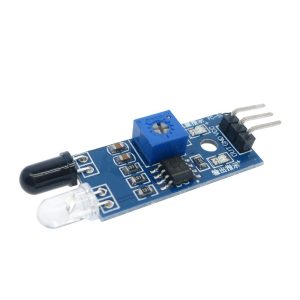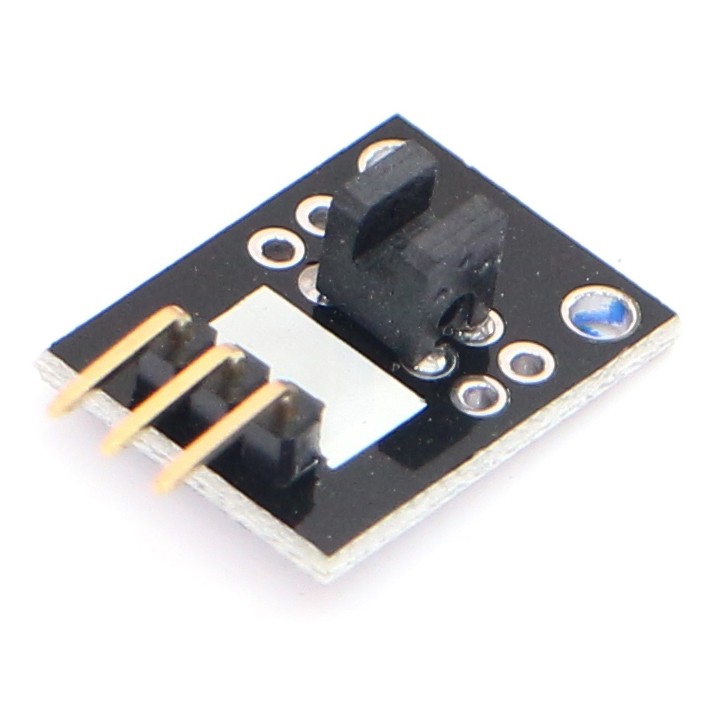
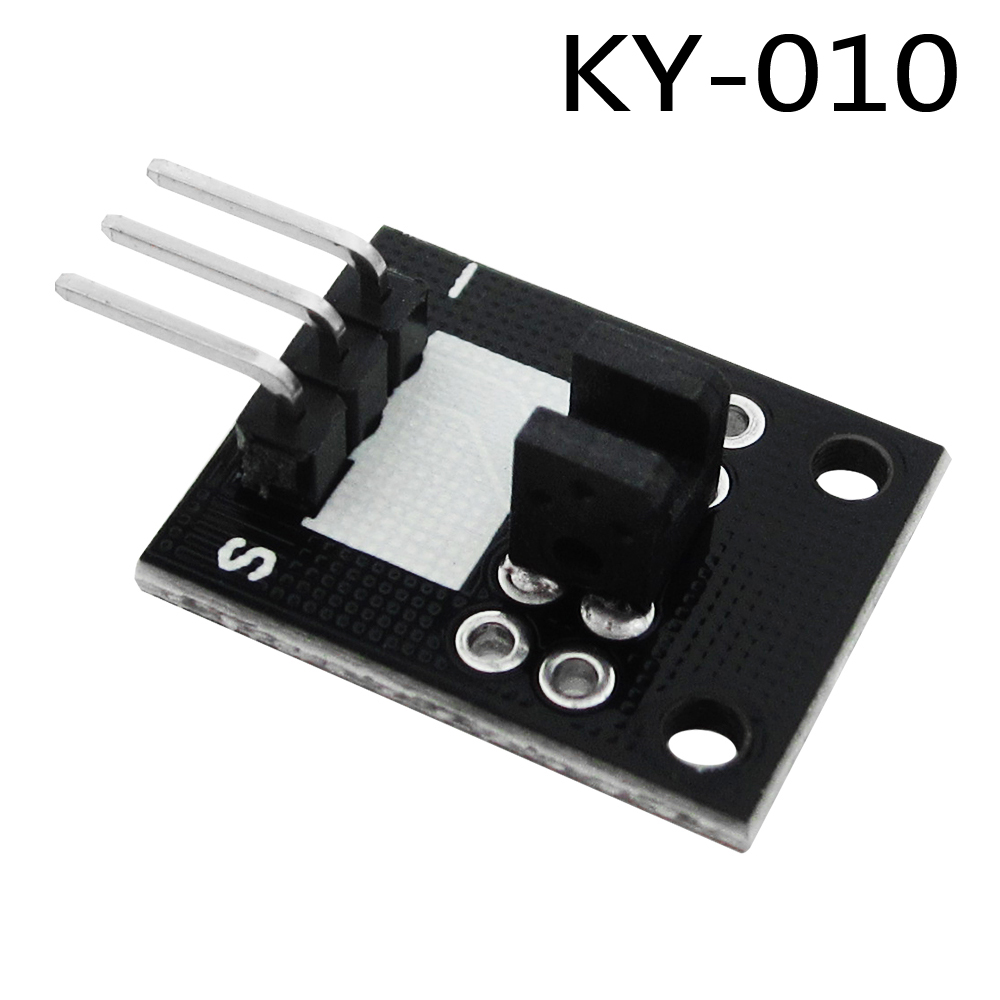
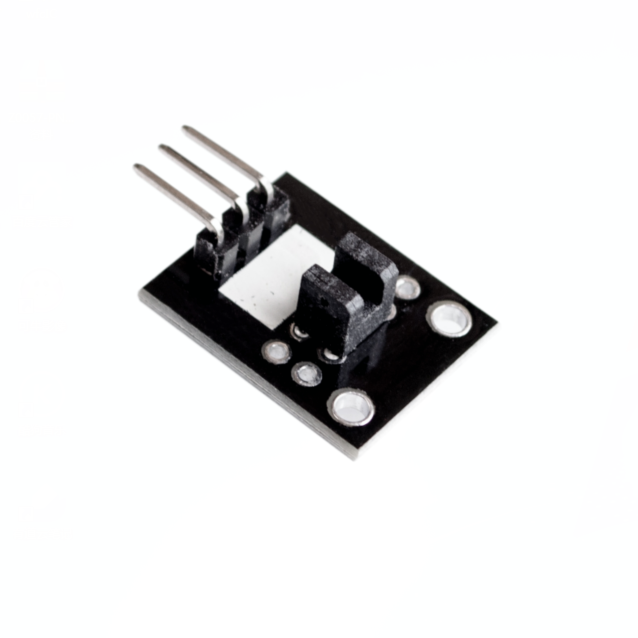
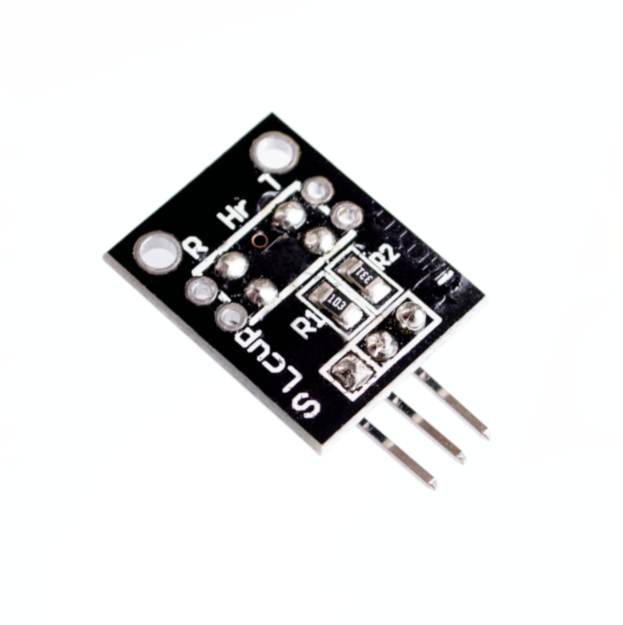
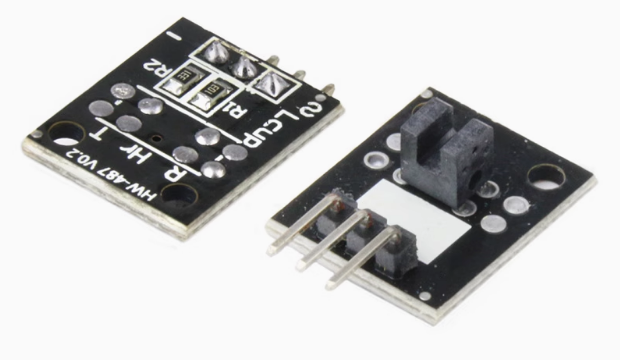
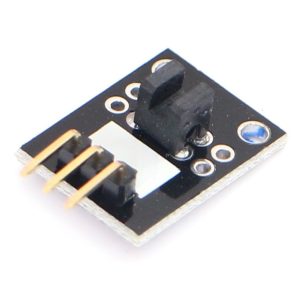
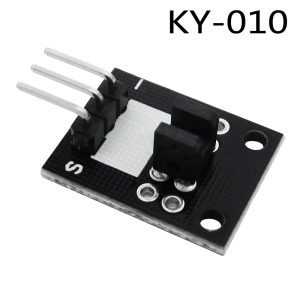
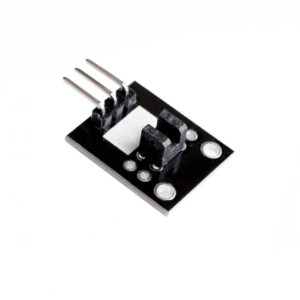
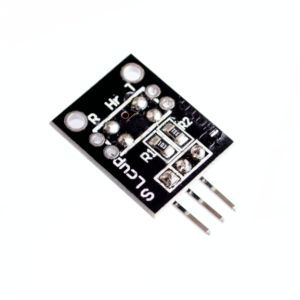
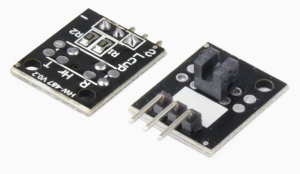
The KY-010 Light Blocking Module is a compact, low-cost optical sensor board designed for Arduino, ESP32, Raspberry Pi, STM32, and other microcontroller projects. It uses an infrared emitter and phototransistor pair arranged in a slotted optical interrupter configuration. When an object passes through the slot and blocks the infrared beam, the module detects the interruption and provides a digital output — making it an ideal solution for object detection, counting, edge sensing, position feedback, and speed measurement in automation, robotics, and interactive electronics.
At the heart of the module is a slotted optical switch consisting of an infrared LED on one side of the slot and a phototransistor on the other. In normal operation, the IR beam passes through the slot and strikes the phototransistor, keeping the output in one state. When an object (such as a gear tooth, paper edge, or rotating disc with slots) passes through the slot and blocks the beam, the phototransistor stops conducting, and the output switches state. This broken-beam detection is highly reliable and repeatable, making it suitable for precise counting and position sensing.
The module includes signal conditioning circuitry that converts the phototransistor’s state into a clean digital output compatible with microcontroller logic levels. The output is typically LOW when the beam is blocked and HIGH when the beam is uninterrupted (depending on the module variant). An LED indicator provides visual feedback when the beam is blocked, making it easy to verify operation during setup and troubleshooting.
The module features a 3-pin interface (VCC, GND, OUT) for easy connection to microcontrollers. The OUT pin can be connected directly to a digital input or interrupt pin, allowing you to count objects, detect edges, or measure speed. The compact form factor with mounting holes allows easy integration into 3D printers, CNC machines, conveyor systems, and custom projects.
The KY-010 operates from a 3.3V to 5V DC supply, making it compatible with both modern low-power microcontrollers and traditional 5V systems. The low power consumption makes it suitable for battery-powered sensing projects.
The KY-010 is widely used in object counting, edge detection, position sensing, speed measurement, 3D printer endstops, CNC limit switches, conveyor belt monitoring, paper detection, anti-theft devices, and educational STEM projects. It is also popular in DIY electronics and maker projects where non-contact object detection is required.
Important Note: The KY-010 is a slotted optical interrupter — the object must physically pass through the slot to block the beam. It is not a reflective sensor and cannot detect objects that do not pass through the slot. The slot width is typically 5mm, limiting detection to objects that fit within this gap. The module is not waterproof and should be kept dry. For best results, ensure the object is opaque and completely blocks the beam when passing through.
Whether you are building a 3D printer endstop, an object counter, or a speed measurement system, the KY-010 Light Blocking Module provides a reliable, affordable solution for broken-beam detection. It is suitable for individual makers, students, and businesses purchasing in bulk for product development or educational programs.
Features
-
Slotted optical interrupter — Infrared emitter and phototransistor for broken-beam detection
-
Digital output — Clean HIGH/LOW signal for easy MCU integration
-
Interrupt-friendly output — Suitable for counting, position sensing, and speed measurement
-
LED indicator — Visual feedback when beam is blocked
-
Wide voltage range — 3.3V to 5V DC, compatible with Arduino, ESP32, Raspberry Pi
-
Low power consumption — Suitable for battery-powered applications
-
Compact form factor — With mounting holes for easy integration
-
Simple interface — 3-pin connection (VCC, GND, OUT)
-
Wide application range — Object counting, edge detection, endstops, speed measurement
-
Cost-effective — Affordable solution for optical detection in volume production
Technical Specifications
| # | Parameter | Specification |
|---|---|---|
| 1 | Module Model | KY-010 |
| 2 | Sensor Type | Slotted optical interrupter (IR LED + phototransistor) |
| 3 | Output Type | Digital (HIGH/LOW) |
| 4 | Operating Voltage | 3.3V – 5V DC |
| 5 | Slot Width | Approximately 5mm |
| 6 | Indication | LED indicator |
| 7 | Pin Count | 3 pins (VCC, GND, OUT) |
| 8 | Module Dimensions | Compact PCB with mounting holes |