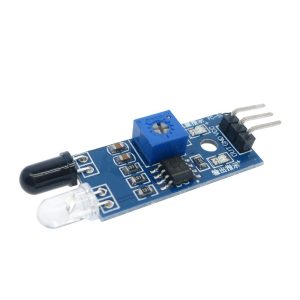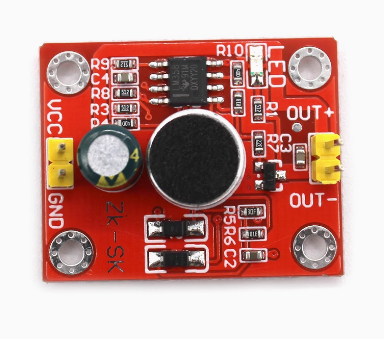
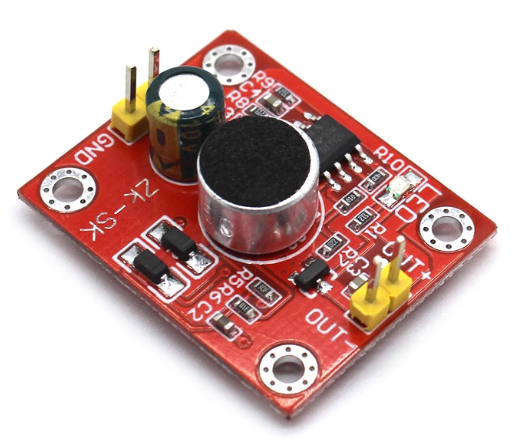
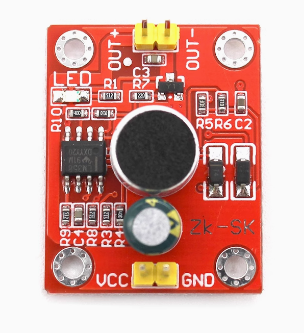
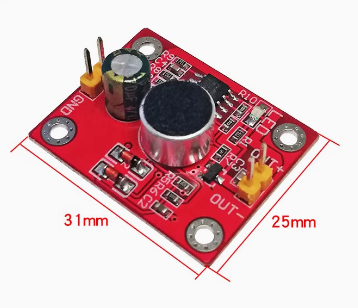
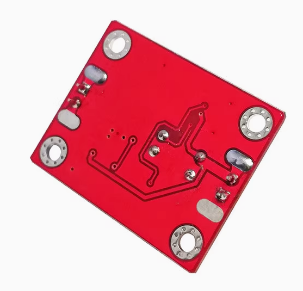
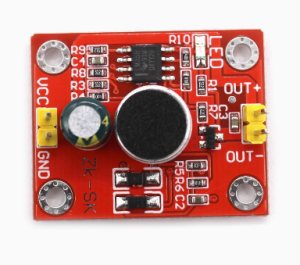
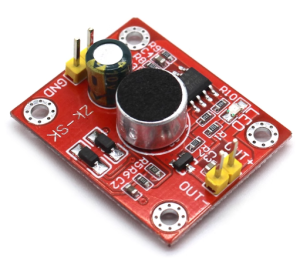
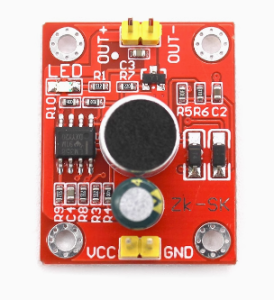
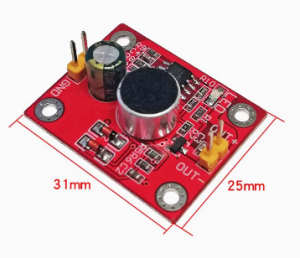
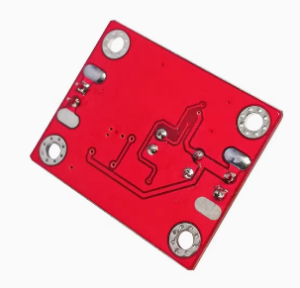
The Voice-Activated Delay Driver Module for LED is a compact, ready-to-use sound-activated switch designed to turn LEDs and other low-power devices on in response to sound, then automatically turn them off after a user-adjustable delay. It combines a high-sensitivity electret microphone, an audio amplifier circuit, and a delay timer on a single board, making it an ideal solution for sound-activated lighting, stairwell lights, corridor illumination, and DIY electronics projects.
At the heart of the module is a high-sensitivity electret microphone that captures ambient sound and converts it into an electrical signal. The signal is amplified and processed by the onboard audio detection circuit, which triggers the output when the sound level exceeds a preset threshold. Once triggered, the module keeps the output active for a user-adjustable delay period, allowing the connected LED or device to remain on for a set time before automatically turning off.
The delay time is adjusted using the onboard potentiometer, with a typical range of approximately 1 second to 10 seconds (depending on the specific variant). This makes the module suitable for applications where a brief sound (such as a footstep, clap, or voice) should activate a light for a short duration. A second sensitivity potentiometer allows you to adjust the sound threshold at which the module triggers, making it adaptable to different environments and noise levels.
The module provides a digital output that can directly drive low-power LEDs (typically up to 100mA) or be connected to a relay or transistor for switching higher-power loads. The compact form factor with mounting holes allows easy integration into light fixtures, control panels, and custom enclosures. The module operates from a 3.3V to 5V DC supply, making it compatible with Arduino, ESP32, STM32, and other microcontrollers, as well as standalone operation.
The Voice-Activated Delay Driver Module is widely used in sound-activated LED lighting, stairwell and corridor lights, closet and cabinet lighting, security lighting, interactive art installations, toys, and educational STEM projects. It is also popular in DIY electronics and maker projects where hands-free, sound-triggered control is desired.
Important Note: The module responds to overall sound intensity, not specific frequencies or voice commands. For voice recognition or specific sound pattern detection, a more advanced audio processing module is required. The module is not waterproof and should be kept dry. For driving high-power LEDs or other loads exceeding 100mA, use an external transistor or relay.
Whether you are building a sound-activated light, a stairwell illumination system, or an interactive project, the Voice-Activated Delay Driver Module provides a reliable, affordable solution. It is suitable for individual makers, students, and businesses purchasing in bulk for product development or educational programs.
Features
-
Voice/sound-activated trigger — High-sensitivity electret microphone detects sound
-
Adjustable delay time — Onboard potentiometer sets delay from ~1s to ~10s
-
Adjustable sensitivity — Separate potentiometer for sound threshold
-
Direct LED driver — Can drive low-power LEDs up to 100mA
-
Wide voltage range — 3.3V to 5V DC, compatible with Arduino, ESP32, STM32
-
Compact form factor — With mounting holes for easy integration
-
Simple interface — Power input and output terminals for easy wiring
-
Wide application range — Stairwell lights, corridor lights, closet lights, security lighting
-
Standalone operation — No microcontroller required for basic operation
-
Cost-effective — Affordable solution for sound-activated lighting in volume production
Technical Specifications
| # | Parameter | Specification |
|---|---|---|
| 1 | Module Type | Voice-activated delay driver for LED |
| 2 | Sensor Type | Electret condenser microphone |
| 3 | Operating Voltage | 3.3V – 5V DC |
| 4 | Output Type | Digital (switches LED on when triggered) |
| 5 | Output Current | Up to 100mA (direct LED drive) |
| 6 | Delay Time | Approximately 1s – 10s (adjustable) |
| 7 | Sensitivity Adjustment | Onboard potentiometer |
| 8 | Pin Count | 4 pins (VCC, GND, OUT, GND) |