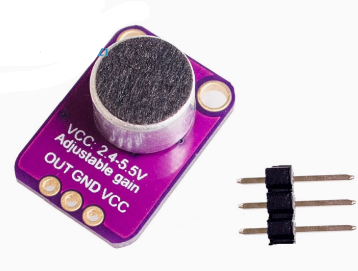
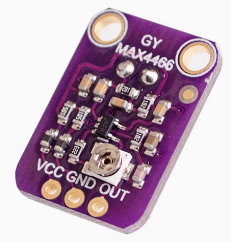
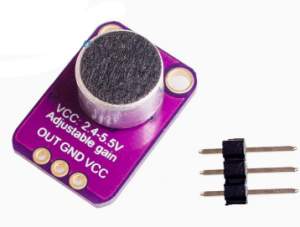
The MAX4466 Audio Amplifier Module is a compact, high-performance microphone preamplifier board designed for Arduino, Raspberry Pi, ESP32, and other microcontroller projects. Built around the MAX4466 operational amplifier from Maxim Integrated (now Analog Devices), this module provides clean, adjustable audio amplification for capturing sound, measuring ambient noise, and building audio-reactive projects. It is an ideal solution for sound level meters, voice recording, clap detection, and audio spectrum analyzers.
At the heart of the module is the MAX4466, a low-cost, low-power operational amplifier optimized for microphone preamplification. It features rail-to-rail outputs, low noise, and high gain bandwidth, making it well-suited for amplifying the weak signal from the onboard electret condenser microphone. The amplified output is available on the OUT pin as an analog voltage that varies with the sound waveform.
The module includes an onboard potentiometer for adjusting the gain from approximately 25x to 125x. This allows you to optimize the output signal level for your specific application — higher gain for quiet environments and lower gain for loud environments. The adjustable gain makes the module versatile for both close-range and distant sound capture.
The analog output connects directly to your microcontroller’s ADC pin, allowing you to sample the audio waveform in real time. This enables a wide range of applications including:
-
Sound level measurement — Calculate RMS or peak-to-peak amplitude
-
Clap and sound detection — Trigger events based on sound thresholds
-
Audio visualization — Drive LED strips or displays with sound-reactive effects
-
Voice recording — Capture audio for storage or transmission
-
Frequency analysis — Perform FFT to identify dominant frequencies
The module operates from a 2.4V to 5.5V DC supply, making it compatible with both 3.3V and 5V microcontrollers. The compact form factor with mounting holes allows easy integration into custom enclosures, portable devices, and sound-reactive projects. The 3-pin interface (VCC, GND, OUT) provides simple, straightforward wiring.
The MAX4466 Audio Amplifier Module is widely used in sound level meters, clap detectors, voice-activated projects, audio spectrum analyzers, noise monitoring systems, interactive art installations, and educational STEM projects. It is also popular in DIY electronics and maker projects where clean audio amplification is required.
Important Note: The MAX4466 amplifies the audio waveform, not just the sound level. The output is an analog signal that follows the audio waveform, so your microcontroller must sample it fast enough (typically 1kHz–10kHz) to capture the signal accurately. For simple sound level measurement, you can calculate the peak-to-peak amplitude or RMS value in software. The module is not waterproof and should be kept dry.
Whether you are building a sound level meter, a voice recorder, or an audio-reactive LED display, the MAX4466 Audio Amplifier Module provides a reliable, affordable solution with clean, adjustable audio amplification. It is suitable for individual makers, students, and businesses purchasing in bulk for product development or educational programs.
Features
-
MAX4466 operational amplifier — Low-noise, rail-to-rail audio preamplification
-
Adjustable gain — Onboard potentiometer for 25x to 125x amplification
-
High-sensitivity electret microphone — Captures ambient sound accurately
-
Analog output — Direct connection to microcontroller ADC pins
-
Wide voltage range — 2.4V to 5.5V DC, compatible with 3.3V and 5V systems
-
Low power consumption — Suitable for battery-powered applications
-
Compact form factor — With mounting holes for easy integration
-
3-pin interface — VCC, GND, OUT for simple connection
-
Wide application range — Sound level meters, clap detectors, voice recording, audio visualization
-
Cost-effective — Affordable solution for audio amplification in volume production
Technical Specifications
| # | Parameter | Specification |
|---|---|---|
| 1 | Module Type | Audio amplifier / microphone preamp |
| 2 | Amplifier IC | MAX4466 |
| 3 | Sensor Type | Electret condenser microphone |
| 4 | Operating Voltage | 2.4V – 5.5V DC |
| 5 | Gain Range | Approximately 25x – 125x (adjustable) |
| 6 | Output Type | Analog (audio waveform) |
| 7 | Bandwidth | 20Hz – 20kHz (typical) |
| 8 | Pin Count | 3 pins (VCC, GND, OUT) |