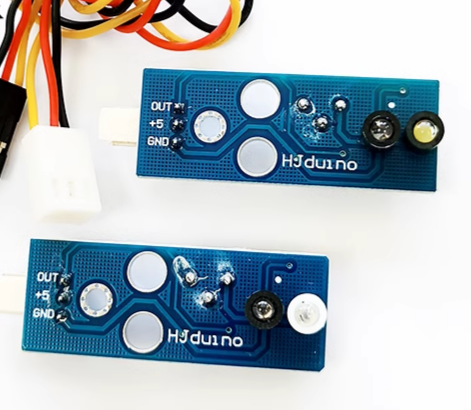
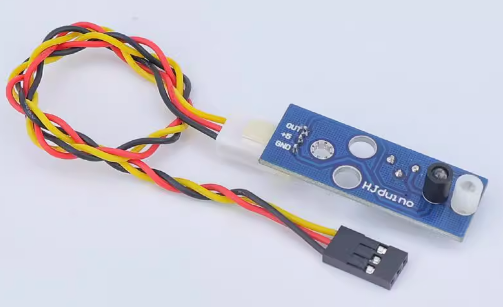
Digital Single-Channel Photoelectric Line Tracker Sensor – Red Light Grayscale Module with 30cm 3PIN XH2.54 to Dupont Cable

SKU: FA3009-3
Sensor Type

Red light photoelectric (LED + phototransistor)

Number of Channels

1 (single-channel)

Operating Voltage

3.3V – 5V DC

Output Type

Digital (HIGH/LOW)

Detection Height

5 – 15mm (recommended)

Sensitivity Adjustment

Onboard potentiometer

Indication

LED indicator

Included Cable

30cm 3PIN XH2.54 to Dupont

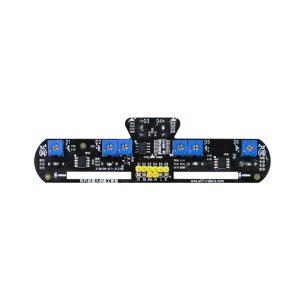
The Digital Single-Channel Photoelectric Line Tracker Sensor is a compact, easy-to-use grayscale detection module designed for line-following robots, edge detection, and DIY robotics projects. It uses a red light photoelectric sensor to detect the difference between light and dark surfaces, providing a clean digital output that indicates whether the sensor is over a white surface or a black line. The module comes with a 30cm 3PIN XH2.54 to Dupont cable, making it ready to connect to your microcontroller right out of the box.

At the heart of the module is a red light LED emitter paired with a phototransistor receiver. The emitter projects red light downward onto the surface, and the phototransistor measures the intensity of the reflected light. When the sensor is over a white surface (high reflectivity), the reflected light is strong, and the output is typically LOW. When over a black line (low reflectivity), the reflected light is weak, and the output is typically HIGH. This binary detection allows a robot to determine its position relative to a line and make steering decisions.

The module features a single digital output that connects directly to a microcontroller’s digital input pin. An onboard potentiometer allows you to adjust the detection sensitivity, making it easy to calibrate for different surface colors, line contrasts, and ambient lighting conditions. An LED indicator provides real-time visual feedback, showing the current detection state at a glance.

The red light sensing element offers advantages over both white light and infrared sensors. Red light provides better contrast on certain colored surfaces and is less affected by ambient visible light than white light sensors, while still being able to detect colored lines and markings that infrared sensors may miss. This makes the module suitable for applications involving colored tape, printed patterns, and grayscale detection.

The module operates from a 3.3V to 5V DC supply, making it compatible with Arduino, ESP32, STM32, Raspberry Pi, and other microcontrollers. The compact PCB design with mounting holes allows easy integration into robot chassis and custom enclosures. The included 30cm cable with XH2.54 to Dupont connectors simplifies wiring and reduces setup time.

The module is widely used in line-following robots, maze-solving robots, edge detection systems, grayscale detection, obstacle avoidance, and educational STEM projects. It is also popular in DIY robotics kits and competition robots where reliable line detection is essential.

Important Note: The module is not waterproof and should be mounted 5–15mm above the surface for optimal detection. Performance can be affected by ambient light sources (such as sunlight or strong indoor lighting) and highly reflective surfaces. For best results, use the module in controlled lighting conditions and calibrate the potentiometer for your specific surface.

Whether you are building a line-following robot, an edge detection system, or a STEM educational kit, the Digital Single-Channel Photoelectric Line Tracker Sensor provides a reliable, affordable solution with the convenience of an included cable. It is suitable for individual makers, students, and businesses purchasing in bulk for product development or educational programs.

Features

  • Single-channel photoelectric sensing — Red light LED emitter with phototransistor receiver

  • Digital output — Clean HIGH/LOW signal for easy MCU integration

  • Adjustable sensitivity — Onboard potentiometer for calibration

  • LED indicator — Real-time visual feedback for detection state

  • Red light sensing — Better contrast on colored surfaces than white light or infrared

  • Wide voltage range — 3.3V to 5V DC, compatible with Arduino, ESP32, STM32, Raspberry Pi

  • 30cm cable included — XH2.54 to Dupont connectors for easy connection

  • Compact PCB design — With mounting holes for easy integration

  • Wide application range — Line-following robots, edge detection, grayscale detection, competitions

  • Cost-effective — Affordable solution for line detection in volume production

Technical Specifications

# Parameter Specification
1 Sensor Type Red light photoelectric (LED + phototransistor)
2 Number of Channels 1 (single-channel)
3 Operating Voltage 3.3V – 5V DC
4 Output Type Digital (HIGH/LOW)
5 Detection Height 5 – 15mm (recommended)
6 Sensitivity Adjustment Onboard potentiometer
7 Indication LED indicator
8 Included Cable 30cm 3PIN XH2.54 to Dupont

Usage

Getting Started

  1. Connect power — Supply 3.3V or 5V DC to the VCC pin and GND to ground. The LED indicator should light up.

  2. Connect the output — Connect the OUT pin to a digital input pin on your microcontroller (e.g., D2 on Arduino, any GPIO on ESP32).

  3. Mount the module — Position the module 5–15mm above the surface, with the sensor facing down. Ensure the sensor aligns with the line for optimal tracking.

  4. Adjust sensitivity — Place the module over a white area and adjust the potentiometer until the LED just turns off. Then place it over the black line and verify the LED turns on.

  5. Upload and test — Write a simple sketch to read the output and verify detection. Use the sensor state to control motor direction for line following.

Output Logic

Surface Reflected Light Output State (Typical)
White (background) Strong reflection LOW (0V)
Black (line) Weak reflection HIGH (VCC)

(Note: Output logic may vary by module variant — verify with your specific module.)

Pin Connections

Module Pin Function
VCC Power (3.3V–5V)
GND Ground
OUT Digital output

Example Arduino Code

cpp
#define SENSOR_PIN 2

void setup() {
  Serial.begin(9600);
  pinMode(SENSOR_PIN, INPUT);
}

void loop() {
  int sensorValue = digitalRead(SENSOR_PIN);
  Serial.print("Sensor Value: ");
  Serial.println(sensorValue);

  if (sensorValue == HIGH) {
    // Over black line
  } else {
    // Over white surface
  }

  delay(50);
}

Typical Applications

  • Line-following robots — Detect and follow a line on a contrasting surface

  • Maze-solving robots — Navigate complex paths using line detection

  • Edge detection — Detect the edge of a surface or material

  • Grayscale detection — Distinguish between different shades of gray

  • Competition robots — Follow colored lines and detect markings

  • Educational STEM projects — Teaching sensor principles and robotics

Notes for Business Buyers

  • Red light sensing — Better contrast on colored surfaces than white light or infrared sensors.

  • Simple interface — Single digital output for easy integration with any microcontroller.

  • Included cable — 30cm XH2.54 to Dupont cable simplifies wiring and reduces setup time.

  • Suitable for bulk purchasing — Ideal for robotics kit manufacturers, educational institutions, and product development.

Q: What is the Digital Single-Channel Photoelectric Line Tracker Sensor used for?

It is a line-tracking and edge detection sensor for robotics, used in line-following robots, maze-solving robots, grayscale detection, and educational STEM projects.

Q: What is the difference between red light, white light, and infrared line-tracking sensors?

Red light sensors offer better contrast on certain colored surfaces and are less affected by ambient visible light than white light sensors. Infrared sensors are generally more immune to ambient visible light but cannot detect colored lines as effectively.

Q: What voltage does the module require?

It operates from 3.3V to 5V DC, making it compatible with Arduino, ESP32, STM32, and Raspberry Pi.

Q: How do I adjust the sensitivity?

Use the onboard potentiometer. Place the module over the background surface and adjust until the LED just turns off, then verify detection over the line.

Q: What is the recommended mounting height?

Mount the module 5–15mm above the surface for optimal detection. Higher mounting may reduce detection reliability.

Q: What is the output logic?

Typically, the output is LOW over white surfaces (strong reflection) and HIGH over black lines (weak reflection). Verify with your specific module.

Q: What cable is included?

A 30cm 3PIN XH2.54 to Dupont cable is included for easy connection to your microcontroller.

Q: Can I use this module outdoors?

Not recommended. Ambient light from sunlight can interfere with detection. Use in controlled lighting conditions for best results.

Q: Is the module waterproof?

No. The module is not waterproof and should be kept dry.

Q: Can I purchase in bulk for a product development project?

Yes. This module is suitable for both individual users and business purchasing, including robotics kit manufacturers, educational institutions, and product development.