ESP32 2.8″ TFT Touch Display Development Board – WiFi & Bluetooth Enabled, Micro USB Interface

SKU: FA2209
Microcontroller

ESP32-WROOM-32 (dual-core Xtensa 32-bit LX6, up to 240MHz)

Memory

520KB SRAM, 4MB Flash

Display

2.8" TFT LCD, 240×320 resolution, ILI9341 driver, 65K colors

Touch Screen

Resistive touch, XPT2046 controller

Wireless

WiFi 802.11 b/g/n (2.4GHz), Bluetooth BT/BLE 4.2

USB Interface

Micro USB (programming and power)

Storage

microSD card slot (SPI interface)

Operating Voltage

5V DC (USB or external)

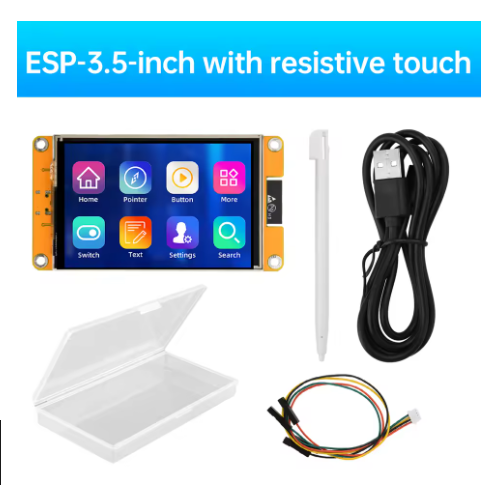
The ESP32 2.8″ TFT Touch Display Development Board is an all-in-one HMI (Human-Machine Interface) solution that combines the powerful ESP32-WROOM-32 dual-core microcontroller with a 2.8-inch 240×320 color TFT LCD and a resistive touch screen. This integrated design eliminates the need for separate display wiring and complex pin mapping, making it an ideal platform for IoT dashboards, smart home controllers, industrial HMI panels, and interactive projects.

At its core, the board features the ESP32-WROOM-32 module, which includes a dual-core 32-bit MCU running at up to 240MHz, with 520KB SRAM and 4MB Flash for program storage. The ESP32 provides WiFi (2.4GHz 802.11 b/g/n) and Bluetooth (BT/BLE 4.2) connectivity, enabling wireless control, remote monitoring, and cloud integration.

The 2.8-inch TFT LCD delivers a 240×320 resolution with 65K color (16-bit RGB) support, driven by the ILI9341 controller. The integrated resistive touch screen (XPT2046 controller) allows for finger or stylus input, making it suitable for menu navigation, button controls, and interactive interfaces.

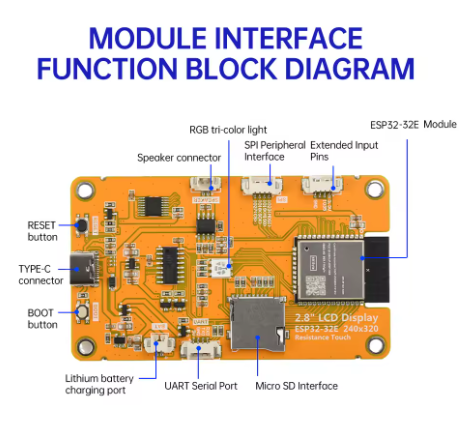
The board is equipped with a Micro USB interface for both programming and power supply, alongside onboard USB-to-UART circuitry that simplifies firmware flashing and serial debugging. A microSD card slot provides expandable storage for images, fonts, and data logging.

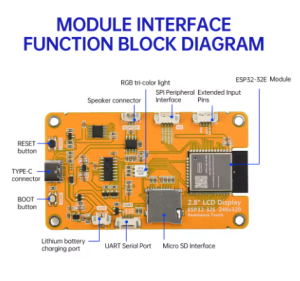
Additional features include onboard speaker support for audio playback, RGB indicator LEDs for status indication, and a lithium battery charging management circuit with a battery socket for portable applications. The board exposes expansion headers (I2C, UART, GPIO) for connecting sensors, actuators, and peripherals, and the module is compatible with Arduino IDE, ESP-IDF, PlatformIO, and MicroPython development environments.

Whether you are building a smart home dashboard, a weather station, an industrial control panel, or a portable IoT device, this ESP32 display board provides a complete, integrated foundation for your project. It is suitable for individual makers, students, and businesses purchasing in bulk for product development or educational programs.

Features

  • ESP32-WROOM-32 dual-core MCU — 240MHz, 520KB SRAM, 4MB Flash

  • 2.8″ TFT LCD display — 240×320 resolution, ILI9341 driver, 65K colors

  • Integrated resistive touch screen — XPT2046 touch controller for interactive input

  • WiFi & Bluetooth connectivity — 2.4GHz WiFi, BT/BLE 4.2 for wireless IoT applications

  • Micro USB interface — Simplified programming and power supply

  • microSD card slot — Expandable storage for images, fonts, and data logging

  • Onboard speaker support — Audio playback capability for notifications and sound

  • Lithium battery charging circuit — Battery socket and charge management for portable use

  • RGB indicator LEDs — Status indication for power, charging, and application states

  • Expansion headers — I2C, UART, and GPIO pins for external sensor and peripheral connections

  • Wide development support — Arduino IDE, ESP-IDF, PlatformIO, and MicroPython compatible

Technical Specifications 

# Parameter Specification
1 Microcontroller ESP32-WROOM-32 (dual-core Xtensa 32-bit LX6, up to 240MHz)
2 Memory 520KB SRAM, 4MB Flash
3 Display 2.8″ TFT LCD, 240×320 resolution, ILI9341 driver, 65K colors
4 Touch Screen Resistive touch, XPT2046 controller
5 Wireless WiFi 802.11 b/g/n (2.4GHz), Bluetooth BT/BLE 4.2
6 USB Interface Micro USB (programming and power)
7 Storage microSD card slot (SPI interface)
8 Operating Voltage 5V DC (USB or external)

Usage

Getting Started

  1. Connect via Micro USB — Use a Micro USB cable to connect the board to your computer. The board is powered and ready for programming.

  2. Install board support — In Arduino IDE, add the ESP32 board manager URL and install the ESP32 package via Boards Manager.

  3. Select the board — Choose an appropriate ESP32 board definition (e.g., “ESP32 Dev Module” or “ESP32 Wrover Module” depending on your variant).

  4. Install display library — Install the TFT_eSPI library for display control and LVGL for advanced UI development.

  5. Configure TFT_eSPI — Open User_Setup_Select.h in the TFT_eSPI library and select the appropriate setup file for your board, or define the pin mapping manually (typically: MOSI=13, SCLK=14, CS=15, DC=2, RST=-1, BL=27, Touch CS=33).

  6. Upload a test sketch — Use a basic TFT_eSPI example to verify the display works. For touch testing, run the Calibration sketch to verify touch response.

Pin Connections (Typical for 2.8″ Display Board)

Function ESP32 Pin
TFT_MOSI GPIO 13
TFT_SCLK GPIO 14
TFT_CS GPIO 15
TFT_DC GPIO 2
TFT_BL GPIO 27
Touch CS GPIO 33
I2C SDA GPIO 22
I2C SCL GPIO 21
SD_MOSI GPIO 23
SD_MISO GPIO 19
SD_SCK GPIO 18
SD_CS GPIO 5

(Pin definitions may vary by board variant — refer to your specific board documentation)

Typical Applications

  • Smart home controllers — Touch-enabled dashboards for lighting, HVAC, and security control

  • IoT monitoring panels — Display sensor data with WiFi connectivity for remote access

  • Weather stations — Real-time temperature, humidity, and pressure display with touch interaction

  • Industrial HMI — Machine control interfaces with touch input and status display

  • Portable devices — Battery-powered interactive displays for field data collection

  • Educational projects — Learning ESP32, display programming, and IoT concepts

  • Product prototyping — Rapid development of touch-enabled IoT products

Notes for Business Buyers

  • All-in-one design — Integrated ESP32, display, touch, and charging circuitry reduces assembly complexity and BOM cost.

  • Ready-to-use platform — Onboard USB-to-UART, Micro USB interface, and battery management simplify product development.

  • Wide development support — Arduino IDE, ESP-IDF, PlatformIO, and MicroPython compatible, reducing team learning curve.

  • Suitable for bulk purchasing — Ideal for IoT product development, educational kits, and industrial HMI applications.

Q: What is the ESP32 2.8" TFT Touch Display Board used for?

It is an all-in-one development board for IoT dashboards, smart home controllers, industrial HMI panels, and interactive projects requiring a touch-enabled display with WiFi and Bluetooth connectivity.

Q: What is the display resolution and driver?

The display is 240×320 pixels with an ILI9341 driver and supports 65K colors.

Q: What touch controller does the board use?

It uses a resistive touch screen with the XPT2046 controller.

Q: Is the board compatible with the Arduino IDE?

Yes. It supports Arduino IDE, ESP-IDF, PlatformIO, and MicroPython.

Q: What library should I use for the display?

Use the TFT_eSPI library for basic display control and LVGL for advanced UI development.

Q: How do I power the board?

It can be powered via the Micro USB interface or through an external 5V supply. The board also includes a lithium battery charging circuit for portable use.

Q: Does the board support audio output?

Yes. It includes onboard speaker support for audio playback.

Q: Can I use this board for battery-powered projects?

Yes. The board includes a lithium battery socket and charging management circuit, making it suitable for portable applications.

Q: What is the difference between this board and a standard ESP32 DevKit?

This board integrates a 2.8″ TFT display, resistive touch screen, SD card slot, and battery management in a single unit, eliminating the need for separate display wiring and reducing component count.

Q: Can I purchase in bulk for a product development project?

Yes. This board is suitable for both individual users and business purchasing, including IoT product development, educational kits, and industrial HMI applications.