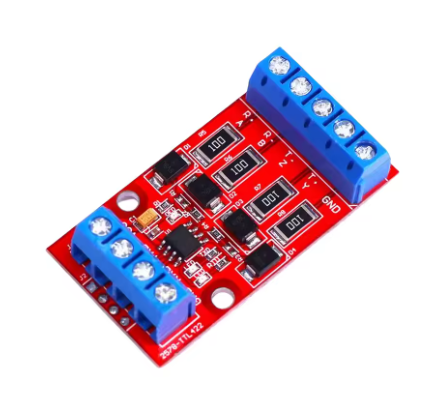
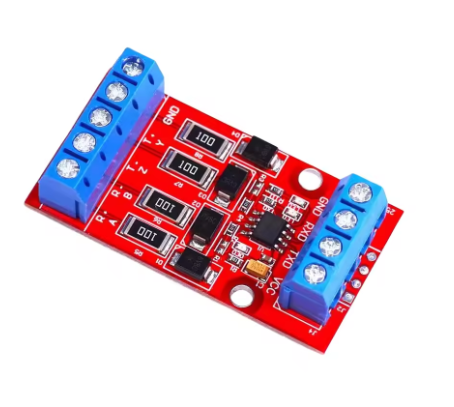
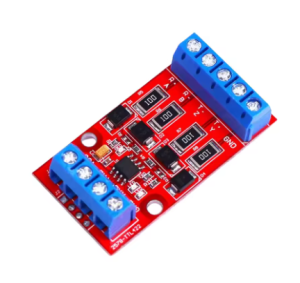
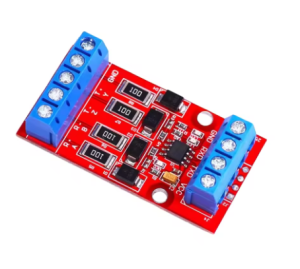
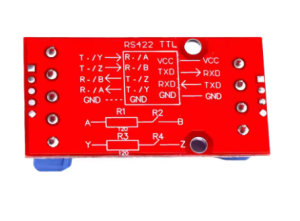
The 3.3V RS422 to TTL Bidirectional Signal Module is a compact, full-duplex protocol converter designed to bridge RS422 differential signals with 3.3V TTL-level UART signals from modern microcontrollers. Built around a reliable RS422 transceiver chip, this module enables long-distance, noise-immune serial communication between 3.3V microcontrollers (ESP32, STM32, Raspberry Pi, etc.) and industrial RS422 devices, sensors, and equipment.
At the heart of the module is a full-duplex RS422 transceiver that provides one driver and one receiver, supporting simultaneous transmit and receive operation. This is a key advantage over half-duplex RS485, making the module ideal for applications requiring continuous bidirectional data flow.
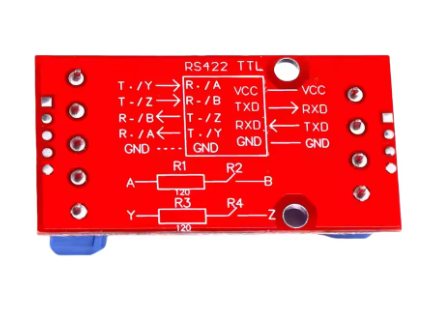
The module performs bidirectional signal conversion:
-
TTL to RS422 — Converts 3.3V TTL UART signals from your microcontroller to differential RS422 signals for long-distance transmission.
-
RS422 to TTL — Converts incoming differential RS422 signals back to 3.3V TTL levels for your microcontroller to read.
The RS422 differential signaling provides excellent common-mode noise rejection and allows cable runs of up to 1200 meters (at lower data rates), far exceeding the range of standard TTL or RS232 interfaces. The module supports data rates up to 2.5 Mbps, making it suitable for high-speed serial communication.
The module is specifically designed for 3.3V logic systems, making it directly compatible with modern low-power microcontrollers without the need for level shifting. This simplifies integration and reduces component count in 3.3V designs. The module is not 5V tolerant on the TTL side — do not connect 5V logic directly.
The module includes screw terminals for secure connection of the RS422 A, B, Y, and Z differential lines, and pin headers for easy connection to your microcontroller’s UART pins (TX, RX, VCC, GND). LED indicators provide visual feedback for power and data activity, making it easy to verify operation during setup and troubleshooting.
The board operates from a 3.3V supply, with low power consumption suitable for battery-powered and portable applications. The compact PCB design with mounting holes allows easy integration into control panels, DIN rails, and equipment enclosures.
The module is widely used in industrial automation, long-distance serial communication, motor control, PLC interfacing, data acquisition systems, security systems, and any application where reliable, noise-immune serial communication is required over extended distances with 3.3V logic.
Important Note: The RS422 standard uses four wires (TX+, TX-, RX+, RX-) for full-duplex communication. Ensure proper termination (typically 120Ω) at the far end of long cable runs to minimize signal reflections. Use twisted-pair cable for best noise immunity. The module is not compatible with RS485 without additional wiring configuration, as RS485 is typically half-duplex.
Whether you are connecting a 3.3V microcontroller to an industrial RS422 device, extending serial communication over long distances, or building a noise-immune data link, the 3.3V RS422 to TTL Bidirectional Signal Module provides a reliable, well-supported solution. It is suitable for individual engineers, students, and businesses purchasing in bulk for product development or industrial applications.
Features
-
Full-duplex RS422 communication — Simultaneous transmit and receive
-
Bidirectional conversion — TTL to RS422 and RS422 to TTL
-
3.3V logic compatible — Direct interface with modern microcontrollers
-
High data rate — Up to 2.5 Mbps
-
Long-distance support — Cable runs up to 1200 meters (at lower data rates)
-
Excellent noise immunity — Differential signaling rejects common-mode noise
-
Screw terminals — Secure RS422 A/B/Y/Z connections
-
Pin headers — Easy UART connection to microcontroller
-
LED indicators — Power and data activity feedback
-
Compact PCB design — With mounting holes for easy installation
Technical Specifications
| # | Parameter | Specification |
|---|---|---|
| 1 | Interface Type | RS422 to TTL (full-duplex) |
| 2 | Logic Voltage | 3.3V TTL |
| 3 | Data Rate | Up to 2.5 Mbps |
| 4 | Supply Voltage | 3.3V DC |
| 5 | RS422 Connections | A, B, Y, Z (screw terminals) |
| 6 | TTL Connections | TX, RX, VCC, GND (pin headers) |
| 7 | Cable Length | Up to 1200m at lower data rates |
| 8 | Module Dimensions | Compact PCB with mounting holes |